Archives for January 2019

How Do I “Write Off” Business Expenses?

Having a registered company (Proprietorship or Corporation) also enables you to pay for lots of stuff with pre-tax dollars as you can write-off a lot of your activities as ‘business expenses’. Again, exactly what you can claim against your taxes will vary according to your region, so either research this online, or hire a bookkeeper or general accountant for an hour to go through it and get you set up.

Deductible expenses might include the business portion of your real estate taxes, mortgage interest, rent, utility, insurance, equipment depreciation, utilities, painting and repairs, meals out (if you discussed business), trips to attend conferences, items bought for research (books, supplements, machinery – anything directly related to your business) and gas and car expenses.

You can see why you’d want to get your business officially set up as soon as possible! YES you can save a LOT of money by charging all these things as “company expenses”. Which means you get to pay for them with pre-tax dollars and save on your personal income tax bill.

Think of it this way: If you get your company to pay for dinner with your friend – where you brainstorm your latest product or service (so it IS a business dinner), you can pay for that dinner using pre-tax dollars. Then the next time you go out with that friend, they can pick up the tab.

So if your meal is a business expense, then your $50 meal costs you $50. But if you paid for that dinner as a personal expense, and you pay 25% of your income in taxes… that meal just cost you $66.67 – because you had to earn $66.67 to be able to pay your taxes and be left with $50 to pay for your meal.

You can see how this would add up quickly! And why it’s worth it for you to research allowable business expenses (also called tax write-offs) in your country, or pay for 1 hour of an accountant’s time to go through it with you. Click here for a quick run-down of what you can deduct in the USA, or in Canada, or in the UK.

How Do I Get Through My Resistance To Telling My Story?

When I tell you how to tell your story (and why it’s crucial to the success of your business that you do so, and do well), I explain why the final decision to purchase is an emotional decision. It is your own personal stories that engage your site visitor’s emotions. Telling stories about your personal journey, or stories about your product or service lets your site visitor get to know you, and then they feel connected to you; they are emotionally engaged.

If someone feels you’re speaking directly to them, if your story touches their heart, or makes them feel recognition and a resounding “yes!” inside them, then you have them.

That’s another reason why scarcity-mentality doesn’t hold up under the light of scrutiny. Scarcity-mentality is a way of thinking that says: You and I need to compete, because there are only a limited number of buyers who will have to be split between you and me.

Let me tell you why that mentality is not only damaging to your business, but simply incorrect.

You and I might be selling exactly the same snow shoveling service (for example) – but my story is ballsy, humorous, with lots of boisterous male energy. Your story vibrates with care, concern and neatness. Are we going to attract the same customer? No.

And unless we live in Florida, there are enough customers for both of us. You don’t need to concern yourself with the competition if you are truly and utterly yourself – because there’s no one else just like you. There’s no one else who has exactly the same story as you.

When you tell your stories, don’t think about what you “should” say, or what people want to hear, or how to manipulate your listener. If you do that, your insincerity will come through louder than any other message. Or people will feel there’s just something a little bit “off” – they likely won’t be able to put their finger on it, but emotionally it will prevent them from buying.

This is why we need to take the time to really focus on your unique strengths and top talents. You’re not working for someone else now, you haven’t been hired to behave a certain way, or project a certain image, or uphold ‘company values’. This is your company – it’s all about you; your journey, your talents, your pain, your triumph, your lessons, your wisdom, your discoveries, your passion and your humour. So tell it like it is! Because your uniqueness will be one of your biggest selling points.

Do It Now!

Ready? Even though your business likely isn’t set up yet, we’re going to pretend it is. Don’t worry, you will need these stories soon.

Read each question one-by-one and immediately write (or voice record) your answer. Or, have a friend ask you the questions and you answer them truthfully and fully:

Your Story

  1. “What made you start this business?”
  2. “How did you come up with the idea for this business?”
  3. “Where did your motivation come from to o er this to people?”
  4. “What’s the story behind your product/service, how did you decide to turn this into a business?”
  5. “Where did you come from, what did you do before this and how did that lead you to here?”

Your Product Story

If you have a product-based business, or you offer a specific service (like tax returns, or healing sessions, or house appraisals), then also tell stories about each of your products or services. Answer all of these questions for each different product or service you offer – and if you don’t know the answer yet, imagine what it could be and write that. Again, pretend your company is already successful and a reporter has called you and is asking you:

  1. “Why did you choose to do this product, instead of product X (another product you could have done)?”
  2. “There are already lots of X on the market, what made you think there was a place for yours?”
  3. “Why is your product be er than all the others?”
  4. “What do you do differently from other companies?”
  5. “Why has your company succeeded when so many others struggle or have failed?”

Don’t worry whether you will use these stories on your site, or not. And don’t start seizing up with excuses and resistance because I just asked you to write your story:

  • I can’t do that, I’m a crap writer!
  • I don’t need to do that, I already know my story cold
  • My story is just not that interesting
  • I feel embarrassed; oh, let me tell you about ME blah blah
  • I’m bored of my story
  • My story’s not relevant to my site
  • I’m a private person, I don’t want to share my personal story*
  • And on and on…

Remember how we talked briefly about not letting fear and saboteurs stop you? And getting your ego out of the way, because this is not about you, it’s about you being the best expression of divine creativity on this planet?

You don’t have to agree with me, you just need to step into allowing. If you want freedom and abundance in your life, you have to go here.

You can call it screwy, you can label it unnecessary, just tell yourself you’re doing it for me and get ‘er done! Trust me, with many of the tasks I ask you to do in this program, the benefits or point of it all only becomes apparent after you’ve completed the task.

And I’m going to make it super easy for you. In fact, this technique is so easy, even a child aged six can do it.

But let’s just talk briefly again about this objection:

 I’m a private person, I don’t want to share my personal story

I mentioned earlier on that you only have to share what you feel comfortable with. However, asking someone for money is an exchange of energy. So energetically it’s not going to work if you ask for someone’s energy without offering some of your own energy in return. And the more true and vital that energy is, the stronger and more compelling it will feel to your website visitor.

Money Is Energy

Think about it. Money is a piece of paper, or an electronic code on your computer and your bank’s computer – there is nothing of actual value there. But it holds symbolic value. We have collectively decided that this 2 cent piece of paper is actually worth $100 and we have all agreed to abide by that symbolism.

And what is $100? Again it is a symbolic representation of the energy required to produce X. For example, if you grow lettuce, it requires energy from you, the soil, the sun, the worms, etc. You then sell your lettuce for $100 to the grocery wholesaler. That $100 is symbolic of all the energy required to grow and harvest that lettuce. So when you give that $100 to the clothing vendor for a new jacket, you are exchanging energy – because guess what produced that jacket? That’s right, the energy of the cotton grower, the soil, the worms, the sun, the sewer, the cutter, etc. etc.

People who imbue their work and their products with their own strong, vital, life-force energy are tremendously compelling – because their products and services carry that same energy. This is not woo-woo stuff, this is physics!

Your own personal stories are the strongest energy you can give. But if you really don’t feel comfortable with that, then find another way to talk about yourself, your motivation, your heart’s desire, that is also strong and resonant with your core.

If you are asking for people to give you their energy (trust, relationship, money) you must be willing to offer yours. Otherwise, it’s unlikely your business will be as successful as it could be.

My entire health empire was launched on the back of my personal story: I healed myself from an incurable disease. I was (and am not) a doctor, health professional, herbalist, nutritionist, etc. Why would anyone listen to me? I wasn’t trying to get people to listen to me or follow me, I was simply throwing my story and my tools/techniques out there and then saying, take it or leave it – listen to your own gut! Do whatever you feel is right for yourself. I wasn’t even trying to make money when I put my first book, Listen To Your Gut, on the Internet. I viewed it as my service to humanity and hoped to just break even.

At that time, I had recently sold my telecommunications company to a software developer in New York (who read about my company in a magazine) for a nice chunk of change and had just given birth to my first child, so I was in cruise mode. I was not even looking or ready to start a new business yet.

However, that book and my willingness to tell the whole truth of my story, my willingness for my story to be of service to others, pretty much magnetized that book and website. I did nothing to promote Listen To Your Gut and it sold rapidly through word of mouth alone – 30 copies a month for the first six months and then increasing to 150 copies per month thereafter ($3742/month revenue).

Most of the strong businesses and brands you’ve heard of – think Apple, Donald Trump, Zappos, Facebook, etc. – embody the passion and energy of the company founder. So when you tell your story (stories) fully and truthfully it is an important way of infusing your energy into your business.

If you have difficulty writing, then just record your answers to the questions on page 21 of your LTYF Workbook using Voice Memo (on your cell phone or iPod), or Quick Time Player on your computer, or some other digital recording device. Remember to put your device into Airplane mode while you’re recording, so you don’t needlessly irradiate yourself.

You can then transcribe your answers, or parts of your answers, to use in your site copy or brochures. Or get someone else to transcribe it for you. So let’s just talk about transcription here as it may be a tool that can set many of you free from limitation (or resistance) very quickly.

Writing vs. Transcription

For whatever reason, I have many friends and family members who are brilliant people, but their brains don’t work the way our industrial education system says they should work. So they get labeled as having a ‘disability’ or they needed ‘learning assistance’ in school.

My eldest son is very kinesthetic (feels, translates, processes and thinks through his body) so he has great difficulty if he sits down to write. The very act of becoming stationary and stopping all movement shuts down his thoughts and he literally cannot think of a sentence.

But if I say to him, “Okay, you walk around, throw a ball and talk and I’ll just type what you say.” Kaboom, a two-page essay flows out of him in about 15 minutes flat; well organized, good progression of thoughts and building upon previous premises, beautiful transitions between paragraphs, etc.

So is he really ‘disabled’ because his body/mind works differently from the people running the schools? The richest person in our family (and I’m talking hundreds of millions of dollars) is ‘dyslexic’. Albert Einstein was kicked out of school. There are hundreds of examples of brilliant inventors and business people who were labeled ‘disabled’ or ‘developmentally delayed’ and whatever other label you can come up with. But are they really?

I invite you to throw out all those useless labels and give yourself your own label. Different doesn’t mean lesser, it can also mean better – it’s your choice. I personally feel that ‘learning disabled’ people have an advantage in the marketplace and they are more likely to be successful – if they can embrace the differentness of their brain and see it as a gift, as an advantage, and then work that baby all the way to the bank!

So stop trying to fit a round peg into a square hole. Is square better than round? No, they are just different. So if all the ‘normal’ holes around you are square, then stop searching for a round hole and make your own! Come up with your own ways of learning and doing and creating and inventing. You have been given a gift! So stop sitting on it, squashing it, trying to bury it, and bring it out in all it’s glory and celebrate it!

So along those lines, if writing is a big chore for you, then don’t try to write. Get a really easy recording device (iPhone, iPod, MP3 recorder, etc.) that can travel with you everywhere. And then get a good, cheap transcriptionist who can take your audio files and transcribe them into text for you.

Fiverr.com is a great, super easy place to hire a cheap transcriptionist. Or pay your kids or your Mom to do it for you – use your family to help out if you don’t have any money yet. Relatives can be paid in barter – cakes, babysitting, lawn mowing, etc. are all hard currency for exchanging tasks you hate to do, or that drain your life force energy.

If you do have some money to be able to hire someone, then head on over to Fiverr.com and get your feet wet! This is exactly the same process I walked my 15-year-old son, Oscar, through as he learned how to outsource for the first time:

  • Use Dropbox to upload your audio file. If your audio file is too big, check out this tutorial on how to compress audio files, or make them smaller. In Oscar’s case, he had handwritten notes from school. So I taught him how to scan them and save as a PDF file, then upload the PDF’s. Or you could take a picture of each sheet of paper with your phone and then upload the .jpg files. It’s all good!
  • Go to Fiverr.com and search the providers under Transcription. In Oscar’s case, he needed to hand in the assignment the next day and it was already 8 pm. So I told him to find someone in India, because night time in North America is day time in India. He paid $5 extra for 24-hour delivery – but he requested it be finished by 6 am PST so he could hand it in at school!
  • Choose a transcriptionist with at least a 90% positive feedback rating from other jobs.
  • After you’ve ordered the gig, you can send a message to your new transcriptionist with the download link or Dropbox details.
  • They will message you back with a download link to the files as soon as they complete your job. In Oscar’s case, the transcriptionist sent the finished files by 4 am, so he had enough time to proofread and format before school started. If you like the job your transcriptionist did, you can save them in your Favorites folder and use them for ongoing work. Here’s my favorite transcriptionist that I use for all my teleseminars.

Congratulations! You just added the first person to your team! Without having to hire any employees and deal with all the paperwork, taxes, and personal drama that goes along with having staff. This is the kind of freedom I’m talking about!

Okay, getting back to telling your stories. You’ve got your method worked out: recording, typing, or writing. And you’ve figured out the environment you work best in: office, beach, café, forest, etc. And you’re all ready to go.

Doing these exercises I give you in the “Plan Your Dream Business” section will help you write your compelling story. And by crafting a story that answers these questions, you will begin building your relationship with your site visitors:

  • Who are you?
  • How did you get to where you are?
  • What journey did you walk?
  • How did you rise like the phoenix from the ashes?
  • How did you turn your frustration, or sadness, or pain into something that makes the world better (and now you are offering that to others)?
  • And why now?

The most common place on your site to use these kinds of stories is on your ABOUT page and you will likely use part of it on your Homepage. But you will also use your stories repeatedly in your marketing materials, teleseminars, interviews, discussions with customers, etc. Ready to go even deeper into your stories? Let’s talk about how you’re going to identify – and connect with – your customers.

How Do I Tell the Story of My Business?

Once you have an idea for your business nailed down, you’re going to need to dig even deeper and uncover your true feelings about your new business. Your feelings, perceptions and experiences are going to combine to “tell your story” about your business – your products, your service, your solution, your help, your fabulous thing that meets their desire or need.

I’m going to take you through this process because you really need to have your story – stories about your products, your services, your journey – up-front in your mind when you’re designing (or rethinking) the presentation and flow of your site. If you only take one thing from it all, let it be this:

People don’t buy objects, they buy stories.

This means that the benefit your buyer will experience is more important than the ‘thing’ you are selling. It means that the final decision to part with money is an emotional one; yes, you also have to meet all the logical, operational requirements, but the final decision as to whether a site visitor buys your widget, or someone else’s, is an emotional, gut-based decision.

Let me share a few examples (stories!) with you to illustrate exactly what I mean and just how important it is to tell stories about your products and process.

Ebay Experiments

David Ogilvy was one of the first big advertising guys to prove that storytelling (a full page worth of small-font size text) sold extremely well.

When we think of story-based advertising, we may think of those mile-long Internet sales letters, or slick ads in niche-market magazines. But the two examples following show the unmatched power of storytelling even in difficult markets like art and flea market sales.

Chris Tyrell, who teaches artists how to market their work, tells a story about an artist who tested storytelling as a sales technique:

The artist I interviewed conducted an experiment by offering the same artwork (an etching) for sale on two different websites. She provided two dramatically different stories about the piece on each site: one story was extremely poignant while the other was mundane. The piece with the compelling emotional story attached to it sold for almost double the price of the same piece that was described in cool, unemotional and technical terms.”

Chris goes on to provide other examples to prove his point and the one that struck me most was an Ebay experiment; where a group of testers took items purchased at thrift stores and flea markets and then put them up for sale on Ebay… with a good story attached.

They hired professional writers to write a unique, interesting, emotionally-driven story for each piece listed for sale.

What they discovered was that $128 worth of second-hand purchases netted them $3600 on Ebay – simply by attaching an emotionally compelling story to each piece! Following is an example of what they did.

They took this wooden animal figure, purchased for 75 cents at a local thrift store:

They listed it on Ebay, along with an emotionally compelling story about how the seller received this handmade, hand painted carving from her boyfriend after he ran off to Cabo San Lucas with her best friend… and it sold for $108.50!!

They also made sure that the photos of each object were good ones (as shown) – presentation always helps. But the bottom line here is that the customer paid 75 cents for the product and $107.75 for the story!

So how can you work more storytelling into your business, products, or service?

So many people are hesitant to tell their personal stories – either thinking they’re not that interesting, they don’t want to boast, or they simply don’t feel comfortable sharing their private details.

Well, if you can’t tell your own stories, find other ones to tell. Or tell a story about something you read or heard about. As long as it’s interesting, or moving, that’s all you need.

Proving The Point

Justin Gignac is a New York City based artist and entrepreneur. He began selling garbage in 2001 after a co-worker challenged him over the importance of package design. To prove his point, he set out to find something that no one in their right mind would ever buy – and package it (story, branding, positioning and presentation) in a way that would sell.

Looking around the dirty streets of Times Square, garbage was the perfect answer. Who would pay money for garbage?

However, Gignac designed the packaging, positioning and branding for his product – NYC Garbage – in a way that was kitschy, attention-grabbing, told a story, and would automatically prompt people to discuss the story (What is that?? Where did you get that? That’s hilarious! etc.). Here’s what his NYC Garbage cubes look like – and note the price point:

Eleven years later, over 1,300 NYC Garbage cubes have been sold and now reside in 29 countries around the world. Gignac has a retail location in New York, along with his online store: www.nycgarbage.com

I’ll say it again: YES, you must have a quality product or service to offer. You can use an emotionally compelling story to sell a crappy product ONCE, but will that person buy again? And will they refer their friends? And will they go on Facebook, forums, blogs, Twitter and recommend you? Probably not.

Will they go to these same social media platforms and insult you and vent their anger and frustration? They probably will. So dig deep into your own integrity and make sure that whatever you sell is something that you yourself would be happy to have spent your money on. And then go tell stories about it.

In fact, let’s start right now, grab your favourite way of writing or recording and answer these questions – these ones are going to be incredibly useful to you written down, so don’t skip this part!


Read each question one-by-one and immediately write (or voice record) your answer. Or, have a friend ask you the questions and you answer them truthfully and fully:

Your Story

  1. “What made you start this business?”
  2. “How did you come up with the idea for this business?”
  3. “Where did your motivation come from to o er this to people?”
  4. “What’s the story behind your product/service, how did you decide to turn this into a business?”
  5. “Where did you come from, what did you do before this and how did that lead you to here?”

Voila! Guess what? You’ve just written your copy for the ABOUT page on your website – didn’t I tell you this would be useful? But wait, we’re not done…


Your Product Story

If you have a product-based business, or you offer a specific service (like tax returns, or healing sessions, or house appraisals), then also tell stories about each of your products or services. Answer all of these questions for each different product or service you offer – and if you don’t know the answer yet, imagine what it could be and write that. Again, pretend your company is already successful and a reporter has called you and is asking you:

  1. “Why did you choose to do this product, instead of product X (another product you could have done)?”
  2. “There are already lots of X on the market, what made you think there was a place for yours?”
  3. “Why is your product be er than all the others?”
  4. “What do you do differently from other companies?”
  5. “Why has your company succeeded when so many others struggle or have failed?”

The most common place on your site to use these kinds of stories is on your ABOUT page and you will likely use part of it on your Homepage. But you will also use them repeatedly in your marketing materials, teleseminars, interviews, discussions with customers, etc.

It is your own personal stories that engage your site visitor’s emotions. Telling stories about your personal journey, or stories about your product or service lets your site visitor get to know you, and then they feel connected to you; they are emotionally engaged.

If someone feels you’re speaking directly to them, if your story touches their heart, or makes them feel recognition and a resounding “yes!” inside them, then you have them.

So if you haven’t yet, just pretend you’re live on-air and answer the questions above – also give any other details, info, or other stories, examples that pop into your mind. Don’t edit now! Just let everything flow out.

Remember, if you hate to write, then grab your mp3 recording device and record your stories. Then you can have someone else transcribe them into a Word document that you can just copy/paste into your website. Either hire someone from Elance or Fiverr, or get your Mum, daughter, cousin, whoever is willing, to do it for you!

And if you’re struggling to start, or you haven’t written down anything that makes you full-of-beans excited for the next step, why don’t we dive a little deeper into why that might be?

How Do I Choose The Very Best Business Idea?

There’s a common mantra in the advertising world: One ad; one message. This same directive is applied to websites:

One website -> One message

Remember, analyses show you only have 3 – 6 seconds to grab your site visitor’s interest before they click away from your site. For this reason, you need to have a super clear message that instantly conveys what you are about and how your stuff can benefit the visitor – in 6 seconds flat.

Now don’t worry, you’ll definitely get a chance to better determine & express your message, but for now, you just need your three top favourite business ideas… and we’re going to narrow it down to just one.

One Thing At A Time

But how will you pick?? Remember, this is not the be all and end all, this is just the beginning!  You can always expand your website, you can always set up another website, you can always take every business idea you have and put it through the Listen To Your Freedom routine again; for each new passion or interest you have.

But to be successful, especially your first time through building an online business, you need to choose just ONE thing. Pick your top talent, or the thing you are most interested in, or passionate about, and start with that.

All your ideas may be stellar. Perhaps several of them combine into a nice roadmap for growing and expanding your business over the next 5 – 10 years. Great! But for right now, you must pick only one. Choose the best one for your current desires, circumstances, ease-of-implementation, financial situation, and listen to your gut! Your gut (intuition) knows which idea you need to start with.

Be Realistic Yet Visionary

Each of you wants to experience greater abundance and freedom. Yet each of you has your own unique set of circumstances and constraints. So, based on your personal situation, the best overall business idea may not be the best idea for you NOW.

Let me give you an example that explains clearly how to apply these principles and then use the same methods to assess your own personal situation.

Let’s pretend that 3 different people are all skilled jewelry makers, and have the same 3 business ideas to choose from. Each person has to look at their own position and circumstances to make the best decision about which business idea to run with.

So let’s say we need to choose the best business idea from these top 3 talents/ideas:

  1. Start an online retail jewellery store, selling my own pieces and also others, specifically for people who love big, artsy jewellery made from natural materials.
  2. Position myself as a jewellery artist, who creates one-of-a-kind commission pieces in my unique style, blending precious gems with metals, wood, hemp and leather.
  3. Offer online courses and instruction, and also local workshops, in making jewellery, jewellery design, incorporating jeweled elements into art pieces and eventually, how to start and run a jewellery business.

Now here’s the list of our 3 people, each in very different situations, with different constraints and different resources:

Jessica: Is single, she is currently employed full-time and has a good-sized paycheque, she has a few thousand dollars seed capital she can use to get going, and she doesn’t have children.

Karen: Has a partner who brings in good money, but there’s not a lot left after paying bills. She has a baby and toddler at home, her kids are her top priority and her only help is her Mom, a few days per week.

Leon: Is single and is on unemployment/disability payments, because he has a chronic illness that keeps laying him up in bed for a week or two at a time. Or he simply doesn’t have the energy to work more than 4 hours per day. At the moment, he has virtually no start-up capital.

Which Biz Fits Which Person?

So which business idea would you tell each of these people to start with? Look at these factors:

  • How much time do they have per day and per week to spend on their business, right now?
  • In the next year or two, will they have more time available, or the same, or less?
  • How much control do they need to have over their success – i.e. if their business goes crazy and orders pour in, will they be able to cope (grow rapidly and expand), or will they self-destruct?
  • How much money do they have to invest in their business?

Examine the effect these starting parameters will have on how much the person can invest (hiring a professional graphic designer vs. do-it-yourself, for example) and also how much time they’ll be able to spend on developing and promoting their business vs. the likely demands of each business idea.

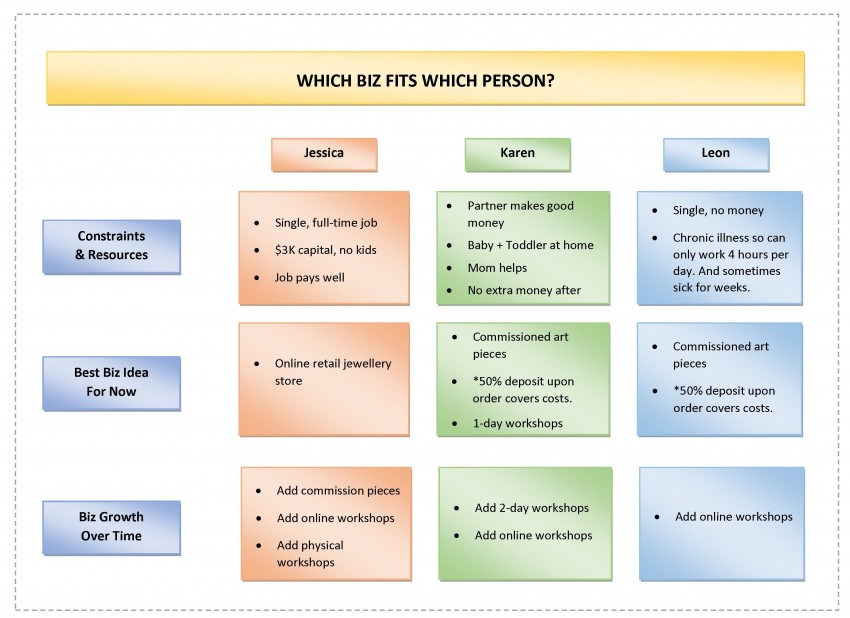
In my opinion, Jessica should go with Idea #1 (the online store) because a retail store requires a lot of inventory, which means money up-front. If she starts by selling other people jewellery lines, she can easily get this going during her time after work and on weekends.

Most of her work will be in the set-up and she can easily power through the intense workload because she is in good health and does not have any kids. Then, as her time allows, she can add her own pieces to her line-up.

Once her business is making good money, she can switch to part-time or flex-time with her job, or quit altogether. If her business explodes and she starts selling to retailers and high-end customers worldwide, she will have the cash (and ability to raise cash) to finance the additional capital required to stock larger inventory and hire support staff. She can also implement Ideas #2 and #3 when and if she wishes.

Karen should go with both Ideas #2 and #3 (commissioned work and instruction). Due to her time constraints, she will only be able to do a few commissioned pieces here and there – but they will also invigorate and re-energize her to the point where they may even make up for missing sleep to work on them!

She will be able to offer one-day local workshops while her Mom takes the kids and if her Mom is really capable and her husband willing to help, she may even be able to do 2-day workshops.

These two features are synergistic because they support and enhance each other. A customer will have a higher perceived value for the jewellery piece if she sees that the artist is also an instructor and mentor for other jewellery artists. And the workshop attendee will be drawn by the idea that the teacher is a professional artist who also makes money selling her jewellery as commissioned pieces, rather than just as a hobby.

This business further works for Karen because she can control and limit her customers and workshops as desired, because her children are her priority.

As her children grow up and once they are in school all day, she could then add Idea #1 to her business.

Leon should go with Idea #2 (commission pieces) and the online course aspect of Idea #3. Because he is severely restricted in both time and money, he needs to go with a business that requires minimal investment and where he can totally control the workload.
If he charges a 50% deposit to begin work on a piece, this will cover all his material costs, so he will not have to fund anything himself. He can also focus on visually-based promotion methods like Pinterest, which require only minutes to implement.

At his own time and pace, he can slowly put together an online instruction course on jewellery making using videos and eBook instruction manuals. He will then have a revenue source that is not tied to his time or presence.

As he has time to blog, he can also add Amazon affiliate links to his blog posts for his jewellery tools, supplies, products, etc. which also take only minutes to implement, but can generate ongoing automated revenue.

If and when his health improves, he can add the other component of Idea #3 (live workshops) to his business and eventually, if he wishes, Idea #1 (the online store selling other jewellery lines).

So here’s a quick look at which business idea best suits each person’s unique circumstances for right now, and how they can grow their business over time:

Here’s another round of the same thing, but this time all three people are already running their own blogs or businesses based around a shared love of outdoor, wilderness and back country exploration. This will give you an idea of how to expand or change your business and/or website after it’s established, in order to suit your new needs or dreams.


So. Each of our 3 business owners need to choose the best business idea from these top 3 talents/ideas:

  1. Start an online retail outdoor gear store, selling my company’s products and also some other select brands, for people who enjoy multi-day backpacking treks and back-country solo sports.
  1. Write a memoir about my backpacking adventures, and sell it online.
  1. Offer online courses and instruction in wilderness survival and back-country preparedness, as well as offering local workshops for beginners to learn about exploring the back-country safely.

Now here’s the list of our 3 hypothetical people, each in very different situations, with different constraints and different resources:

James: Already owns and operates a small local retail business that manufactures his innovative tent design and also sells top-quality outdoor gear. He loves what he does but is getting tired and wants to increase his revenues so he can afford to spend more time with his kids. He’d also like to use that breathing room to set up some automated income related to his business and passion.

Celine: Works part-time to allow for hiking and camping trips, and maintains a blog about her adventures. She’s a mom of two, has a partner making a good salary, and she has a little spare time and some seed money saved away that she’s willing to invest in her own business.

Paula: Has a basic website featuring herself as a back-country guide or consultant for hire. She currently has a regular client who contracts her to be the back-country guide at a wilderness lodge for half the year. She runs her business so that she makes enough to get through the other six months, but has no capital left over. She has no kids or partner and lots of spare time, but after a few injuries she’s realizing she won’t be able to run her guiding business forever. She’s a fantastic photographer, and has a huge collection of original shots from years spent in the bush, just sitting around on flash drives.

Which Biz Idea Fits Which Person?

Remember the factors we need to look at:

  • How much time do they have per day and per week to spend on their business, right now?
  • In the next year or two, will they have more time available, or the same, or less?
  • How much control do they need to have over their success – i.e. if their business goes crazy and orders pour in, will they be able to cope (grow rapidly and expand), or will they self-destruct?
  • How much money do they have to invest in their business?

In my opinion, James should go with Idea #1 (creating an online component to his retail store), because he has the capital and the inventory, as well as the supplier contacts and business know-how, to run an online store.

Most of his work will be in the set up, which he can either do during slow times at the shop, or, outsource the website design and programming, and use his time to delegate and oversee the building of his website.

Once the online store is making good money, he can hire employees at his storefront and switch to a part-time management role, while he keeps an eye on the site from home. If his business takes off and he starts selling to retailers and customers worldwide, he’ll have the cash (and earning ability) to finance a larger inventory and hire more support staff.

People with existing retail businesses may underestimate the sales growth that can come from simply launching an online version of their existing store. But if you already have a physical, retail business, you are primely positioned to add an online store with very little extra hassle. Think about it: You already know what sells, you have relationships and payment terms with manufacturers and distributors already set up, you already have warehouse or storage space for products and you likely already have a relationship with your bank for a loan or line of credit.

The original Garden Pharmacy


Let me give you an example: My cousin and his biz partner own a physical retail pharmacy in Covent Garden in London – a prime retail location – and they were already generating over $2 million/year in revenue from the physical store; which also has a spa (nails, facials, waxing, etc.) and a special section for high end cosmetics and perfumes.

When they launched the online version of The Garden Pharmacy, their sales doubled within a year. But the really amazing thing they discovered is that many of their local customers – who literally lived with 5 minutes walk of the pharmacy – preferred to order online because it was easier! And you know what happens when you make things easier for people… they buy more frequently.

Re-brand of retail pharmacy to match online store

Of course, with such a rapid increase in sales, my cousin had to find additional warehouse space and also hire more staff to fulfil orders – but again, not a big deal when you have cash flow pouring in! But if you don’t have that kind of cash available, outsourcing warehousing and order fulfilment is a great way to set yourself up so that you can grow as big and as fast as the market allows, with no extra work or hassle for you!

So getting back to James and his outdoor gear store: After he’s launched the online version of his existing retail store, when he feels he’s ready, he can step aside even more and create more time and space to implement ideas #2 (writing a book) and #3 (creating and teaching courses and workshops) if he likes. Since his outdoor gear store is well-known at this point, he will have a large email list of opt-ins and customers, who already appreciate his dedication and expertise, and who will be interested in his books and courses.

At this point, he could easily step back from the front lines and manage his automated income from book sales, online programs, and his online store (or any combination of the above) with a minimal amount of work hours from the convenience of his laptop.

Of course, if his online store does really well, and he wants to reduce his work load and hassle factor even more, then he could close down his physical retail store (removes the overhead of rent and the hassle of staff), use a contract manufacturer to produce his tent, outsource all his product warehousing and fulfillment, outsource his online ordering and customer service and then just handle the money and oversee things from his computer. Once everything is set up and running smoothly, he shouldn’t need to spend more than 5 – 10 hours a week just to keep things rolling.

This is the business model we use for our online health store. We sell over 350 products on our website and we have outsourced every component, so that we can go to Hawaii for a month or two with no disruption whatsoever to our business or revenue.

Now let’s take a look at Celine; who works part-time to allow for hiking and camping trips, and maintains a blog about her adventures. She’s a mom of two, has a partner making a good salary, she has a little spare time and some seed money saved away that she’s willing to invest in her own business.

Celine could start with Idea #2, writing a book. Since she’s been blogging all this time, she already has most of the material needed for a book! She can use her free time to compile her posts, add to them wherever needed, and format her book into a self-published eBook and/or physical book, which she can then sell on her existing site, using LTYF tools to increase traffic to her blog.

Idea #3 (online and local courses and workshops) would also be easy to implement on her existing blog site, especially as her book starts to take off and people who want to get into back-country exploration start asking her for advice. She can shift the focus of her hiking and offer some of that time to small local groups who want to learn about wilderness survival, gear preparation, or who just want a mentor until they feel confident to hike by themselves.

She could even add Idea #1 (online retail store), but instead of going to the trouble of manufacturing, warehousing and shipping products, she could create an online affiliate store, where she collects affiliate cash from sales made through her website.  She can use her blog to review and recommend products from her own personal experience, and receive 40 – 60 percent commission on any sale made through her website.

This way, she can even score some great equipment from companies who’d like her to review their products – once she’s gathered a large enough email list and positioned herself as a trusted expert in the field. That way she’ll never need to put down capital on her store – unless, once she’s established, she wants to go ahead and start manufacturing her own brand, or retailing other brands!

These features are synergistic because they support and enhance each other. A customer will be more likely to trust her judgment and recommendations of products if he sees that Celine is not only a down-to-earth, nature-loving backpacker like him, but also also an instructor and mentor who uses the same gear in the back-country that she’s selling on her site.

Being a published author greatly increases her credibility, and her workshop participants will certainly be interested in reading her book. They will also be drawn in by the fact that she is a notable outdoor gear expert with years of in-the-field experience, as seen on her blog.

This business further works for Celine because she can control and limit her in-person workshops as desired, and be virtually hands-off on her affiliate store, because her children are her priority.

But remember, the LTYF directive is to start with just one thing. So in Celine’s case, she would start with the book or eBook. And her site would focus on that – she would base this first pass through LTYF on that ONE business idea and get it up and running. As she becomes fluent with the LTYF tools and process, she can add in the other parts of her overall plan.

Now let’s check in with Paula. Remember, Paula contracts her services (featured on her basic website) as a back-country guide at a wilderness lodge for half the year. She runs her business so that she makes enough to get through the other six months, but has no capital left over. She has no kids or partner and lots of spare time, but after a few injuries she’s realizing she won’t be able to run her guiding business forever. She’s a fantastic photographer, and has a huge collection of original shots from years spent in the bush, just sitting around on flash drives.

Paula should go with Idea #3 (online courses and in-person workshops) first. Because she has six months off every year, she has plenty of time to create content to offer online, teach classes or workshops in person, and take beginner groups out for short hikes to learn the ropes of back-country exploration. If she wants to limit all heavy physical activity to give her injuries time to heal, she can focus on the online aspect, as well as more technical or theory-based workshops.

This is the best idea for her because it’s a natural extension of what she’s already so good at, and loves doing, but is less pressure on her body and has more potential to generate income. She also already has all the photos she’ll need to illustrate her courses and what she’s teaching! And if she needs live, action video for her courses, then she can shoot it during her guide trips, or during her 6 months off.

Here’s something else to keep in mind: Paula’s online course could also appeal to the back-country version of the “armchair traveler”. Many people purchase travel books, guides and videos with no intention of ever leaving home! Think of National Geographic magazine; the opportunity to live vicariously through the guide or adventurer is enough.

Maybe Paula will discover a huge market for her courses in Germany – of people who dream of someday visiting the wilderness of North America, but for now, this is the closest they can get to actually experiencing it. Or maybe she will also produce a course on wilderness survival and appeal to off-the-grid groups and survivalists. NOTE: She would want to do some keyword research to make sure these groups can find her site.

And if Paula chooses to do another season or two of guiding, the online courses can still generate extra automated income while she’s away.

Paula also has time to blog – and she has a ton of great stories and photos from her guiding business.  She can add Amazon affiliate links to her posts for all her favourite gear and tools, and/or set up an affiliate shop like Celine, all of which generate ongoing automated revenue.

In her own time, she can collect her stories and pictures together into a beautiful coffee-table book and sell that on her site as well (Idea #2). And if it comes time to quit guiding all together, with the capital she’s generated over time with these different ventures, maybe she wants to implement Idea #1, and start building her own brand of gear to retail online.

But again, you see how Paula needs to choose just ONE of the ideas based on her top talent, and start just with that one thing first? So she would use the rest of the LTYF program to get her first online course produced and available for sale on her website – while building an email list of people interested in back-country exploring.

Okay, that’s a lot of information! So let’s pull it all together into an easy chart. Here’s a quick look at which business idea best suits each person’s unique circumstances for right now, and how they can grow their business over time:

Ready to figure out what your final idea (for this moment in time) is going to be?


Write down your top 3 business ideas (if you don’t have any yet, go generate some!):

1.____________________

2.____________________

3.____________________

Now based on the detailed examples above and the parameters we ran the ideas through, which of your business ideas do you feel would be the best one for you to start with? Ask yourself these questions (and write down your answers!):

How much time do you have per day and per week to spend on your business, right now?

In the next year or two, will you have more time available, or the same, or less?

How much control do you need to have over your success – i.e. if your business goes crazy and orders pour in, will you be able to cope (grow rapidly and expand), or will you self-destruct due to family demands or illness? Plan accordingly:

How much money do you have to invest in your business?


Consult Your Critics and Encouragers

If you’re still not sure what you should do, go back to the wise people in your life. Choose a mix of people who are supportive and people who are more critically-minded, as they will help find the holes in your ideas.

Present all three ideas to each of these people and ask them which one they think is the best of the lot? Which one do they think ‘fits’ you the best? And which one do they think is the best business venture for you at this time?

After you’ve brainstormed all three ideas further with these helpful people, you’ll likely have a better idea of which one you want to implement; or implement first.

So do that now: go back to your list of your top three business ideas and pick one of them. Pick the one where you feel a “click” in your gut when you ponder it.

Pick the one that realistically is most likely to meet your current needs and provide a launch pad for you.

Pick the one that is easiest to launch and just get started.

Pick the one that motivates you the most.
 Pick the one you love the most.
Pick the one that makes your heart sing the loudest.

And write it down. Don’t worry, you can come back and improve on this idea if you get more inspiration after listening to the Audio and watching the videos in the next few units.


My Best Business Idea For Right Now:

________________________________

WHY:

________________________________

________________________________

________________________________

________________________________


Need a little more to go on? Here’s a good overview of common questions and dilemmas faced by people trying to choose which business idea to go with.

In the audio for this module, I dispel common business myths and share some of the most effective tips and strategies I’ve found that work really well in choosing the best idea to launch by listening to your freedom, instead of your fear.

  • Learn why going by the books and adhering to age-old business wisdom isn’t always the best way to go.
  • Explore creative ideas to generate funding or investment for projects you don’t actually have the capital for
  • Get inspired by real-life stories of unconventional (and successful!) approaches to business

And much more!

Click here to download the audio (right-click and Save As): Choosing Your Best Idea

Or click PLAY to listen:

Audio Follow-Up

At around 6:40, I reference defining who your ideal customer is – you can learn more about the basics of this process, or you can jump to an energetic way to connect with potential customers.

At 8:30 we talk about ideas for financing – we’ve got lots more about creative, out-of-the-box ways to use your credit cards to finance your business, secure loans from family or friends, get a bank or investor to back your idea, or even crowdfunding for your new business or product.

17:00 – LTYF forum – edit out

And if you still need more for your brain to chew on, why don’t you spend some time checking out your “competition” and defining your own special niche?


How Do I Set Myself Apart From My Competition?

When you have a niche, or business idea that you are excited about and want to pursue, or when you’ve got something up and running but business is slow, pull back for a short time and do a quick scan of your competitors in that niche.

This will give you a good look at whether your idea is specialized enough to stand out, or not. If you find that it isn’t, it doesn’t necessarily mean that you have chosen a bad idea, or that the market is already flooded with people doing what you want to do, so you better find a new idea. Not at all. Remember all you have learned about your special uniqueness!

What this will help you to do is realize where you need to emphasize, develop, or dig deeper to REALLY set yourself apart from others, or where you need to speak more authentically to your ideal customer.

Kitchen Wisdom

Let’s take the Recipe Blog niche as an example. Been online lately? You’ll notice that the Internet is completely flooded with really great baking and cooking blogs. This niche is super-developed, with gorgeous photos, original artwork, cohesive branding, cookbooks for sale, you name it. Sounds like a bad niche to pick doesn’t it? Even if you love cooking more than anything.

But wait! Look for the opportunities, look for the holes in marketplace…

Let’s say you specialize in gluten-free baking – that’s a niche specialization isn’t it? Go search for gluten-free baking sites, research your competition, and you will find the same thing: Thousands of them. So dig further…

What about gluten-free and sugar-free? Ah now we’re talking! Sugar is used in abundance to make up for the browning and mouthfeel missing from gluten-free (GF) baking. Go ahead, try and find sites with great recipes for GF, sugar-free baking. Good luck. Because there are very few – and none that I’ve found with good recipes – good enough that my kids will eat them.

So now we have niched down within your field of interest to a sub-sub-category that is wide open and begging for inspiration and leadership! What if you became the expert on healthy, natural sugar substitutes like stevia, xylitol (from hardwood trees, not GMO corn), lo han guo (Chinese fruit extract) and Thaumatin (extracted from African Ketemfe berries). AND you become one of the few places where customers can purchase these sweeteners?

Or, what if you realize that everyone features printed recipes and photos. So you decide to stand out by shooting a video for every recipe. Maybe you wear kooky outfits, or maybe you love haute couture, so you dress to the nines – you choose a visual persona that encapsulates YOU. And that becomes yet another way to stand out.

Glam Girl Rachel Khoo in her Tiny Paris Kitchen

Maybe you’re a guy and you talk about photography while you’re cooking. Maybe you tell jokes, or goof around, or swear a lot. There are hundreds of ways to differentiate yourself! Just make sure you are pulling out or emphasizing an authentic part of you, not acting.

Maybe you take it one step further and you go gluten-free, sugar-free and grain-free… Now you are hitting the paleo diet market, the digestive disease market and the weight loss market. Maybe you become the place to go for supplies and you come up with a killer grain-free flour blend of potato flour, coconut flour, almond flour and cassava flour. Nobody else is selling this blend and as your recipes become popular, and word of your culinary prowess spreads, you decide to package up your blend and sell it on your website, and then on Amazon. And then into Whole Foods.

Okay, I’ll stop there! But you get my point: Finding out you have rigorous competition, or that your market is already flooded, doesn’t necessarily mean you have to find a new idea, or different niche to play in. It may just mean you have to dig deeper, specialize further, and become even more unique or different.

But you DO have to take a look at what’s happening in your chosen field. See what people are already doing, so you can figure out how to make yourself stand out.

Don’t put your head in the sand and invest hundreds of hours of work and wads of cash in a doomed enterprise, just because you are afraid to take an honest look around you. Knowledge is power and lemons can always be made into sugar-free lemonade!


Mac “How-To” Videos

Alright Mac users, here are a few videos to help answer your questions. You can click on the link that best matches the question you have, or you can just scroll through the videos to find the one you need. And remember…for everything else, there’s Google!


How do I…


Learn the Mac In Under An Hour

How to Add Storage to Any Mac Laptop

iWork Full Tutorial

Pages 5 – Full Class with Extras 2013

iPhoto 11 – Full Tutorial

iTunes 11 – Full Tutorial

Apple Mail Tips and Tricks

Excel for Mac Basics: Lesson 1 – Create a new blank workbook in Excel 2011 + Playlist (can watch all the vids in this series)

PC “How-To” Videos

Alright PC users, here are a few videos to help answer your questions. You can click on the link that best matches the question you have, or you can just scroll through the videos to find the one you need. And remember…for everything else, there’s Google!


How do I…


Microsoft Office Basics for PC

PowerPoint 2010 Tutorial for Beginners #1 Overview (Microsoft PowerPoint)

PowerPoint 2013 Training – Creating a Presentation – Part 1

PowerPoint 2013 Training – Creating a Presentation – Part 2

Microsoft Excel 2010 Tutorial For Beginners #1 – Overview + Playlist (can watch all the vids in this series)
22_01*you need to watch these on YouTube (click on the video) – we are not allowed to embed these here for you.

Microsoft Excel 2013 Training Tutorial + Playlist (can watch all the vids in this series)

Transfer Your Data from PC to Mac

Audacity Tutorial – Import, Basic Edit, Export

How To Find Keywords Using Google Keyword Planner

How To Use Google Drive (AKA Docs)

How To Add Words to Photos or Artwork (using GIMP for PC – Free)

How To Add An Opt-In or Sign-Up Box To Your Blog

How To Add a Free Slideshow To Your Blog (MetaSlider)

How To Take Photos of Your Computer Screen (Screenshots)

How To Make A Video Using PowerPoint

Create Infographics, Diagrams, or Website Design Using Free Google Drawing

How To Change The Social Media Icons On Your Blog

How To Add Amazon Affiliate Products or Links To Your Blog