How Do I Use Crowdfunding to Finance My Project?

Crowdfunding is a way to utilize the financial power of a ‘crowd’ rather than just trying to find one individual, or company, or bank to finance your clearly defined project.

Crowdfunding can be used to finance a large variety of projects, from political or health documentaries, to music albums, to yoga outreach classes, to new inventions, to fashion, food products or cookbooks, games, book publishing, etc.

The only stipulation for a crowdfunding project is that it must be very clearly defined; both in scope and results.

Crowdfunding is a method that allows startups and individuals to raise money from small investors, fans, friends, family and anyone who is referred via your Facebook page, Twitter, Pinterest, Instagram, your blog, email campaign, etc. You can use any combination of these social media tools to drive potential backers to your crowdfunding page, which can be hosted at a number of different sites, like these:

Each of these crowdfunding sites has a different slant on which projects they prefer. Some lean more toward political or civil causes, others towards the arts, or technology, or teaching projects. So visit all of them and see which one fits with your project the best.

Some of these sites require you to obtain pledges for the complete amount you are asking for, within a certain time frame, or the funds aren’t released and the project is cancelled. Sites that do this, like Kickstarter, say this method works best because it creates urgency and motivates people to pledge their donations quickly, as well as protecting both parties from attempting to implement an under-funded project.

Other sites, like Indiegogo, do not have these restrictions. In fact, Indiegogo offers you the option of holding a Fixed campaign, where you must meet your fundraising goals, or a Flexible campaign, where you keep whatever you raise.

GoFundMe even allows you to fundraise for ANY reason – including medical bills, your wedding, animal rescue projects, etc. So take a look at the crowdfunding sites given above and pick the one that best suits your needs.

Note: All of these crowdfunding sites (given above) are also supported by YouTube – except for GoFundMe. This means that you can embed a link to your fundraiser page right in your video, onscreen: “Click here to visit my fundraising page and help me out”. Go to the Annotations section in YouTube support for clear, easy instructions on how to do this.

What Makes A Campaign Successful?

There are a number of elements that need to be in place for a crowdfunding project to be successful, aside from just being able to get people to visit your crowdfunding page.

Each of the crowdfunding sites listed above has guidelines, FAQs, or tutorials to give you the knowledge and tools you need to carry out a successful campaign. Since they are taking a commission from your revenues generated, it is very much in their interest for you to succeed.

I suggest you go to a few of these crowdfunding sites and have a look through a few of their most successful campaigns. All of them feature their top projects for you to study and see what common elements make for a successful campaign.

You’ll probably notice that all successful crowdfunding projects have these elements in common:

  • Very well organized and laid out, so backers can judge how realistic the project’s goals are.
  • Clearly explained objective, purpose and steps to achieve that; with a clear beginning and end. The good campaigns use sub-titles to break up their text and communicate clearly what each section is about.
  • The person launching the project is completely sincere and talks to potential backers in his/her own style and language.
  • Excellent photographs or video to provide a strong visual of who they are and what they want to achieve with their project.
  • All of the above combine to give the backer a clear idea and feeling that the project creator has the ability to complete the project as described.
  • Pledges start very low (often $1) and as they increase, they offer good rewards that backers would be glad to receive and that are directly related to the project.

Currently on Kickstarter, the most popular pledge amount is $25 and the average pledge is around $70. Small amounts with a free reward (a gift) for donating yield the best results. Projects without a reward at the $20 level or less, succeed only 28% of the time. But projects with rewards set at $20 (and lower) succeed 45% of the time. Many projects start their pledge amounts at only $1 and then begin offering rewards at the $10 mark.

When deciding what to offer as your rewards, offer something of value. Actual value matters more than just retail sticker price. For example, if you offer a reward that’s a limited edition item, or a one-of-a-kind experience, then there’s a lot more flexibility in setting the reward dollar value, based on your audience. But if it’s a manufactured good, then it’s a good idea to stay reasonably close to its real-world retail price.

Every project should be as creative and true to itself as possible. Put yourself in your backers’ shoes (the people you are asking to back you): would you drop the cash to support your project? And are the rewards motivating enough to help you say ‘yes’? The answer to that question will tell you a lot about your project’s potential.

Another way you can test whether your project is strong enough, is to search whichever crowdfunding platform you chose, for a project that YOU will support. And then actually DONATE to it – go through with all the steps involved with pledging your money to support that project. After you’ve done that, break down the project fundraising page into the elements that convinced you to part with your money. Now make sure your fundraising page has all those things too.

The added bonus to this little exercise is not only are you putting out what you want to get back, but you are now in the autoresponder email sequence for that project. So you can see how the person reaches out to you AFTER the ‘sale’ and how they communicate with you to honor the relationship after you’ve given them money. And of course, swipe away! Copy anything you like and customize it for your own project.

How about you? Have you ever thought of utilizing Crowdfunding to raise money for a project, or product you want to create?

Explore your ideas in your notebook…


Crowdfunding can be a great way to raise money for a project, or product you want to create. Is there anything you’d like to offer the world that could be created faster if you had some funds? Brainstorm your ideas here:


If you’re ready, draft your own crowdfunding proposal, along with sub-titles to answer reader’s questions, and the rewards you can offer to supporters (don’t forget to highlight the different sections of your proposal):


Here are some great examples of types of projects on Kickstarter that work well for crowdfunding and also how each of them set up their project page to be clear, inspire confidence and make it easy for fans, friends and family to contribute.

Please go and visit each of these examples live, so you can see how and why they were successful. Feel free to swipe the way they have organized their pitch, or presented their content.

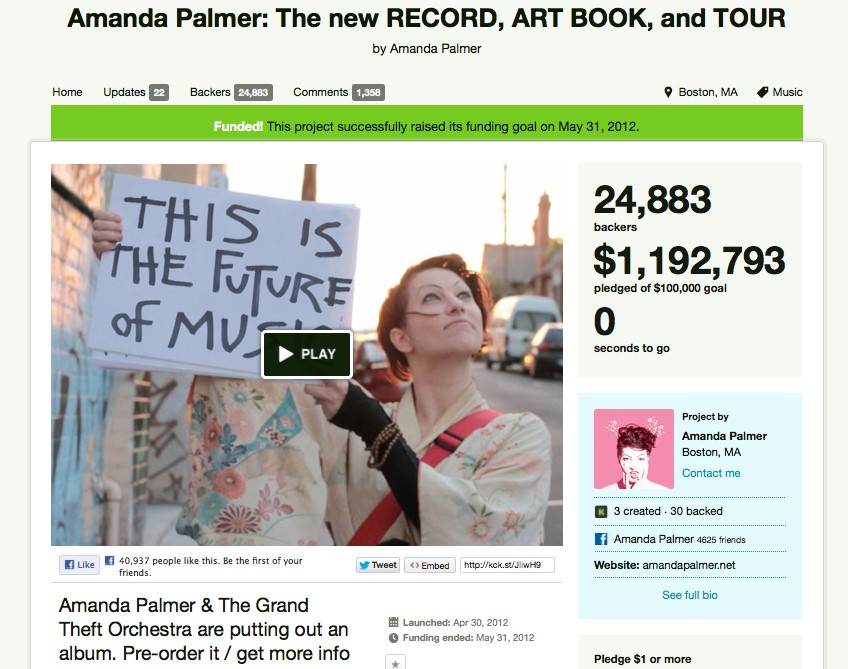
Amanda Palmer: The new RECORD, ART BOOK, and TOUR

Goal: $100,000
Pledged: $1,192,793

Singer/songwriter Amanda Palmer spent four years writing a record and putting her band together. Formerly part of the Dresden Dolls duo, Palmer broke away from a major record label to do her own thing. The album, supported by Kickstarter, was the first million-dollar music project on the Kickstarter platform. The album debuted in the top 10 of the Billboard Charts a few months later.
20_01

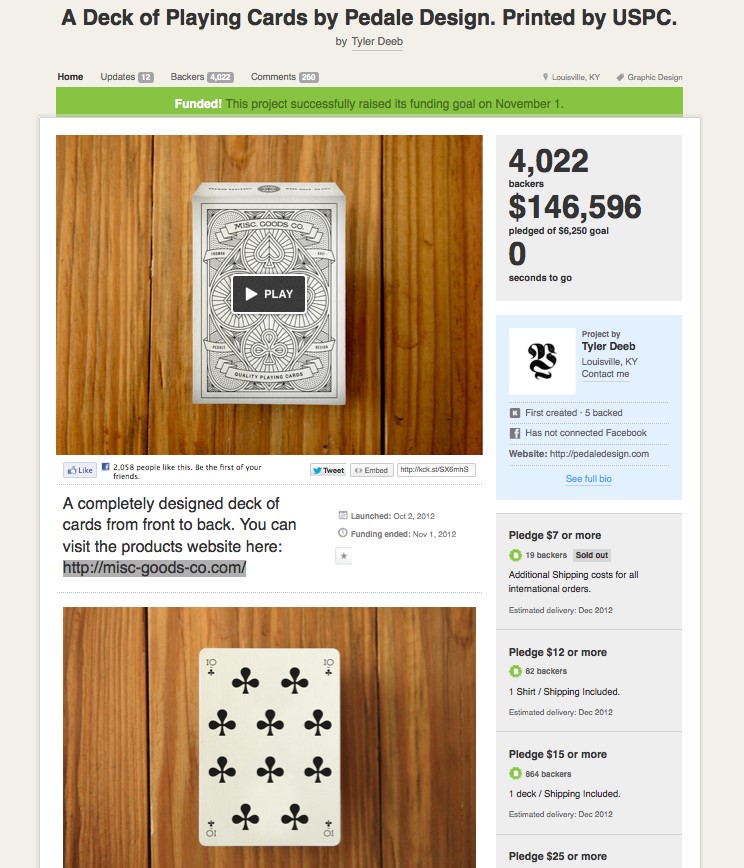
A Deck Of Playing Cards by Pedale Design

Goal: $6,250
Pledged: $146,596

Graphic designer Tyler Deeb’s project on Kickstarter is a perfect example of someone turning two of his skills and interests into income. Tyler wanted to design (he inked each playing card by hand) his version of a gorgeous deck of cards. He is also a card player who was bored with the same old deck of cards every time he sat down to play.

Points to note about Tyler’s project are that he presents top quality photographs of a number of the finished cards – showing he can actually deliver what he is promising.
20_02

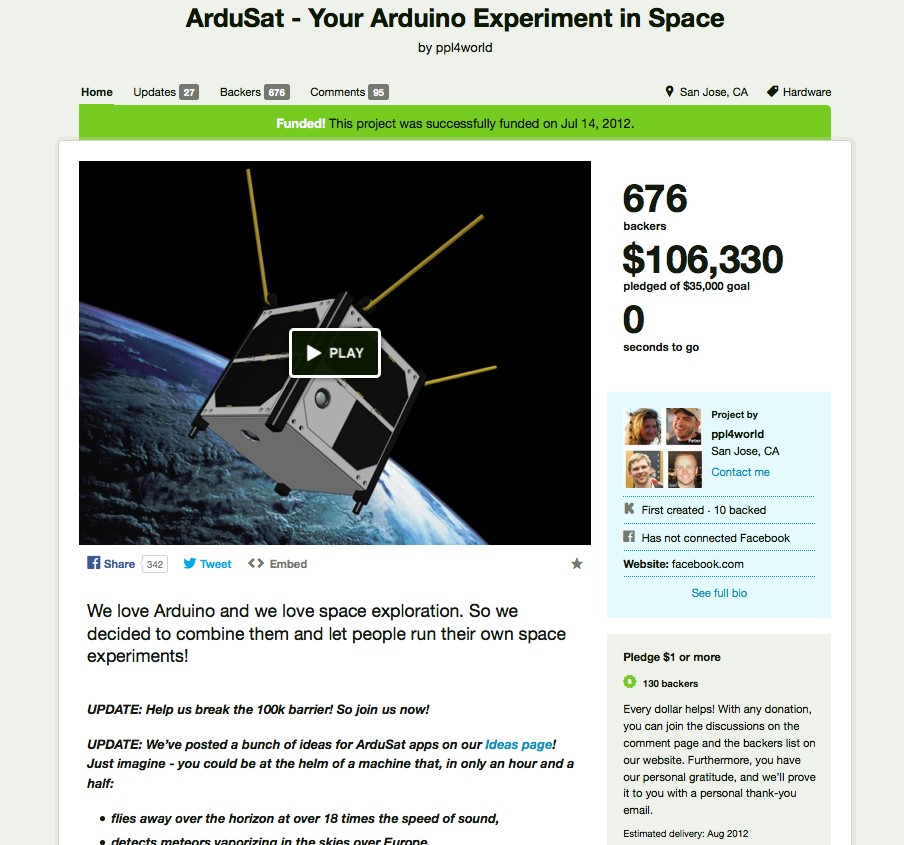
ArduSat – Your Arduino Experiment in Space

Goal: $35,000
Pledged: $106,330

ArduSat is a tiny satellite that weighs no more than 1kg, but it has made a huge impact on the future of space research. Created by NanoSatisfi, this Kickstarter project went well beyond its $35,000 goal in just one month.

The project has democratized space exploration, making it feasible for anyone to run his own space experiment, depending on how many pledges he gets.
20_03

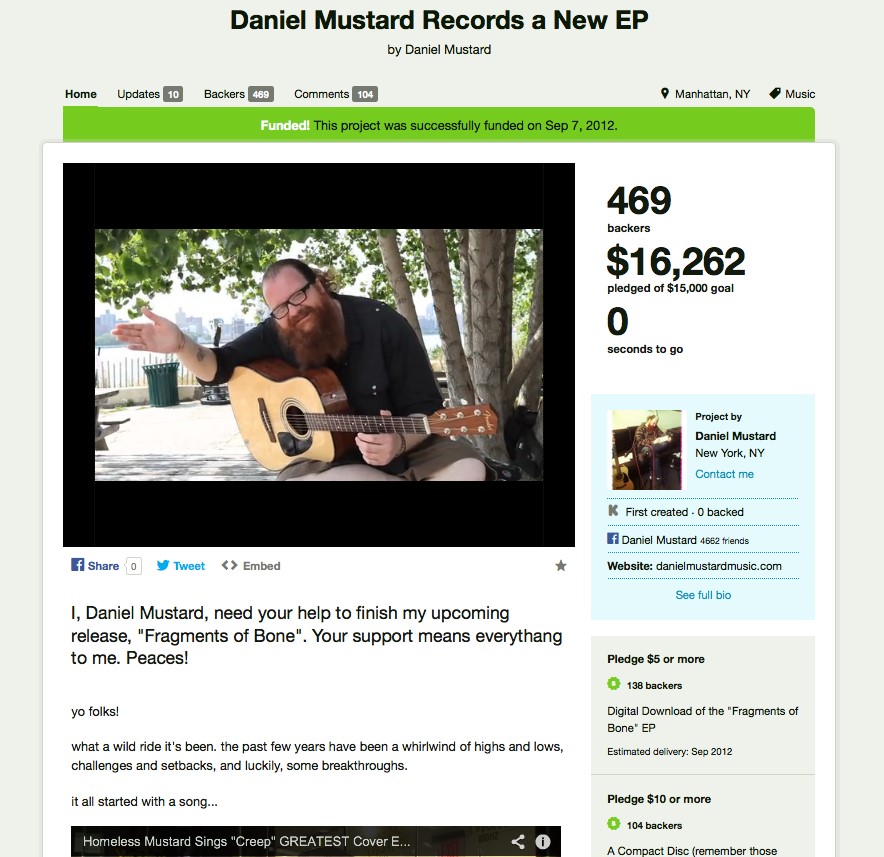
Daniel Mustard Records a New EP

Goal: $15,000
Pledged : $16,262

In 2009, when Daniel Mustard was homeless, his cover of Radiohead’s “Creep” went viral on YouTube. Mustard told Mashable the exposure gave him back his will to live.

Mustard lauched a Kickstarter project in July to pay for the cost of producing and distributing an album. Most of the songs were inspired by his tribulations. The musician is no longer homeless, having found temporary access at shelters and using the Internet to mingle with fans at Apple stores.
20_04

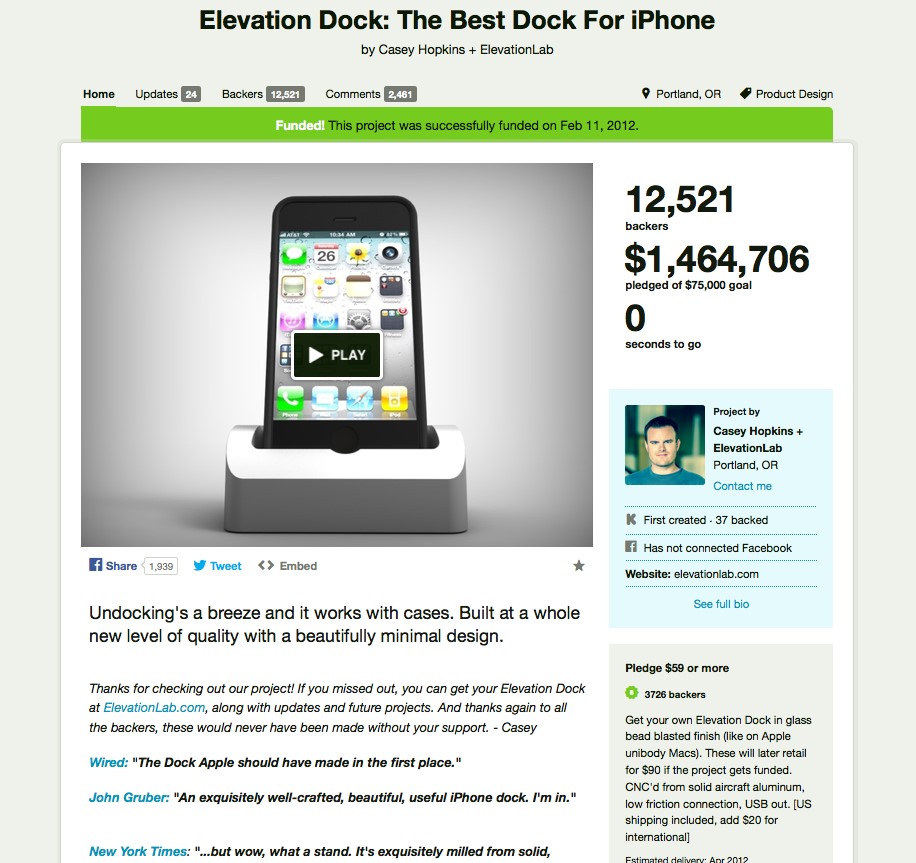
Elevation Dock: The Best Dock For iPhone

Goal: $75,000
Pledged: $1,464,706

The Elevation Dock was a simple concept with one main mission: to make docking an iPhone as seamless as possible, especially when the device is in a case.

This was obviously a common problem among iPhone users. Designer Casey Hopkins and ElevationLab were the first million-dollar project on Kickstarter. And the dock set the bar for high-quality craftsmanship.
20_05

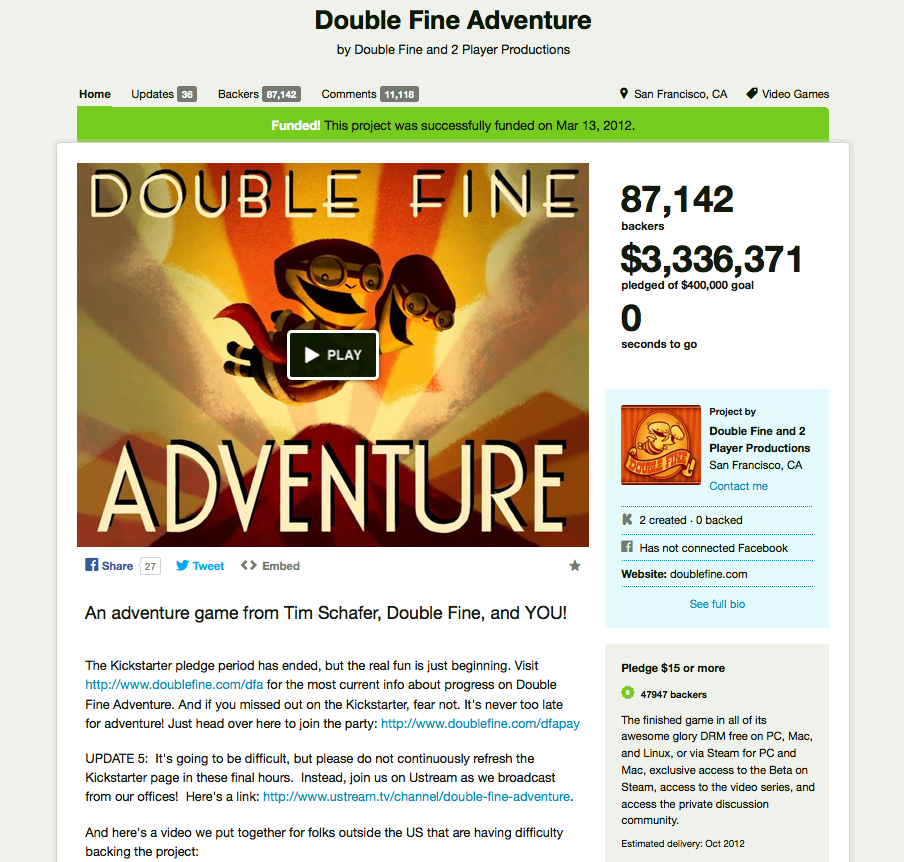
Double Fine Adventure

Goal: $400,000
Pledged : $3,336,371

2012 was a particularly groundbreaking year for gamers on Kickstarter. One of the most important projects, Double Fine Adventure became the first multi-million dollar video game campaign.

The game reached its $400,000 goal in less than 24 hours, making it one of the fastest-funded projects on Kickstarter. Gamers suddenly realized their ideas were viable, and more campaigns like the ones for OUYA and Shadowrun Returns had the opportunity to shine.
kicks-double-fine.jpg

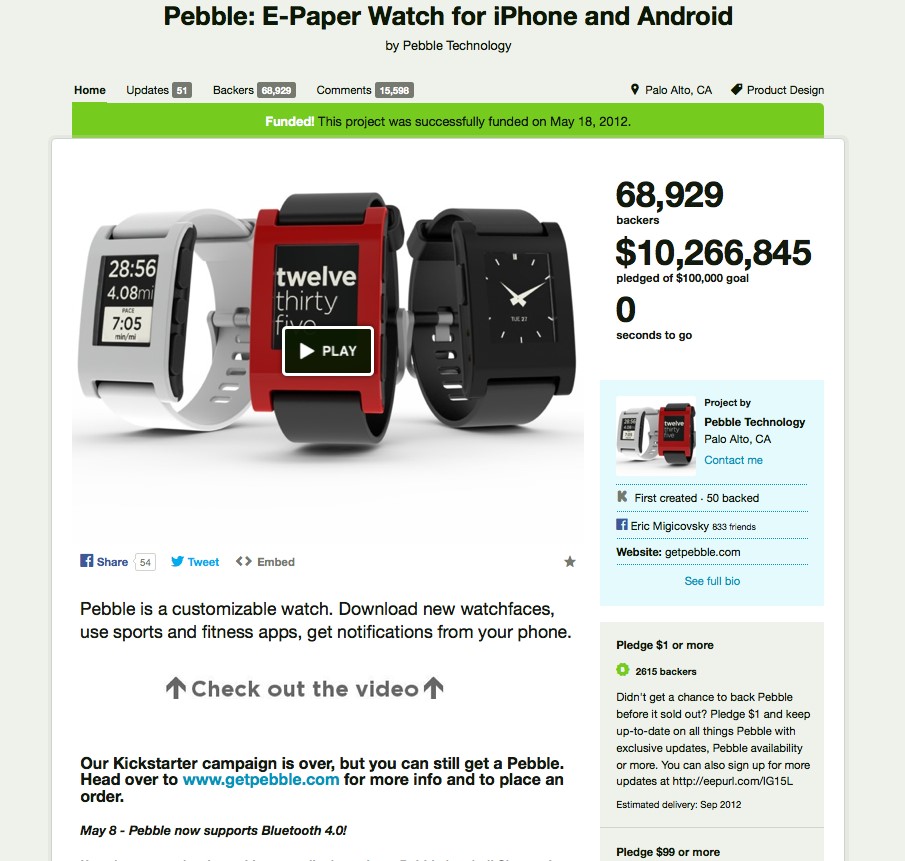
Pebble: E-Paper Watch for iPhone and Android

Goal: $100,000
Pledged: $10,266,845

An iPhone-friendly wristwatch, another seemingly simple concept, nonetheless blew up overnight. The makers at Pebble Technology had a modest $100,000 goal, but reached $1 million in a little more than a day.
20_07

These Days: A Novel

Lastly, here’s a Kickstarter campaign from Jack Cheng asking people to fund the publishing and printing of his first novel. It’s a great guide to use in terms of how to present and organize your text – which I will paste below for you to see…
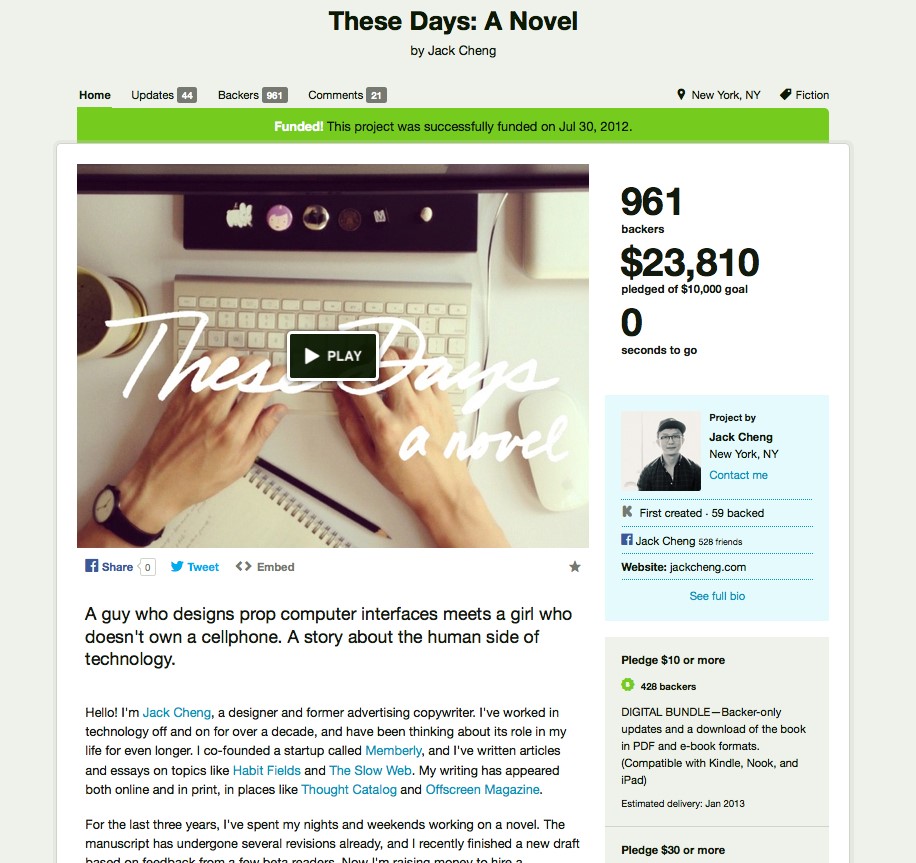
20_08

Here’s Jack’s copy from his fundraising page. I’m including it here as it’s a very good framework to swipe and adapt to your project. Note how he uses sub-titles, bullet points, speaks from his heart, and includes all the details a backer would want to know:

A guy who designs prop computer interfaces meets a girl who doesn’t own a cellphone. A story about the human side of technology.

Hello! I’m Jack Cheng, a designer and former advertising copywriter. I’ve worked in technology off and on for over a decade, and have been thinking about its role in my life for even longer. I co-founded a startup called Memberly, and I’ve written articles and essays on topics like Habit Fields and The Slow Web. My writing has appeared both online and in print, in places like Thought Catalog and Offscreen Magazine.

For the last three years, I’ve spent my nights and weekends working on a novel. The manuscript has undergone several revisions already, and I recently finished a new draft based on feedback from a few beta readers. Now I’m raising money to hire a professional editor and publish the book in a range of formats.

Synopsis

These Days is about Connor Vast, a guy who designs fake computer interfaces for plastic prop displays in furniture showrooms. He meets a girl who doesn’t own a cellphone and is as disconnected as he is connected. As their relationship develops, he falls in with a group of entrepreneurs out to invent the future, but it’s the same future she’s rebelling against. It’s a story about the human side of technology—the people who make it, the reasons they build, and the people on the other end.

Length and Sample Pages

The current draft is approximately 250 pages. You can read an unedited sample of the first four pages here.

Where the Funds Will Go

contabilidadYour backing helps me do two things: it helps me make the book better, and it helps me get the book into the hands of the right readers. I don’t have the resources of a big publisher, but that’s not a bad thing. It just means that the constraints are in different places, and it’ll take some ingenuity and a startup-like mentality on my part. It also means your support is crucial to making These Days a success.

More specifically, your backing helps me with the following:

  • developmental editing
  • line and copy editing
  • proofreading
  • allow printing in bulk to bring down the per-book costs
  • purchase of fonts and other design assets
  • obtaining ISBN numbers, paying registration fees, and additional costs associated with getting listed in various online bookstores
  • envelopes, packing materials, postage
  • extra copies in case of “breakage” (those that get lost in the mail, etc.)
  • extra review copies

I’ll be detailing the entire process via backer-only updates along the way.

Why I’m Printing a Physical Book

For all the distances we travel between the pages of the book, the physical object itself is a souvenir of that experience. Like all souvenirs, the object is a memory device, so that when our eyes glance over the cover on our shelves, we are pulled momentarily and subconsciously into these past worlds and emotions. The nicks and creases and tea stains that patina the object over time further ground it in our memories, reminding us of where we were when we read the book, what we were doing, who we were with. The object is a conversation hook, an invitation to friends who stop by before going out on Friday night, and strangers you meet on the train in the sweltering New York summer. And the object is a ticket to return, a ticket that never expires.

e-reader and notebook coverI buy physical books. I buy e-books. Both have their advantages, but I believe that at this moment in time, a physical book is still a vastly superior interface for the stories I cherish. These are the books I find myself reading over and over again. These books have hard covers but they are also soft and yielding—they are forgiving to our different ways of highlighting and annotating. They can be dog-eared and marked up and still work when you drop them. They may not have search boxes, but their contents are imminently discoverable, especially when you’re not sure what exactly it is you’re trying to find. And they never run out of batteries.

My goal for this project is to tell a story worth cherishing, complete with an artifact—a souvenir—appropriate for the experience.

– –

Video credits: the background music is “Lattice” by Darren Harper. Nearly everything was shot on an iPhone.


The examples I’ve given you here show how you can use crowdfunding to finance a wide variety of projects – rather than trying to get a loan from a bank, or putting everything on your credit card.

I’ve also seen many crowdfunding campaigns for much smaller amounts, like $500 or $1000.

Just remember, you need to have a very clearly defined, specific project to be able to use crowdfunding. You can’t use crowdfunding to pay your rent, or buy real estate, or sell equity, for example – although remember that GoFundMe has very broad parameters of what’s allowable.

Each crowdfunding site has its own specific guidelines as to exactly what they allow and what is not allowed – so be sure to read through these guidelines when choosing your crowdfunding platform.

If you think crowdfunding would work well for your project, but you’d like more specific guidance, or, you’re going to be fundraising for a large amount, then you may want to hire a specialized crowdfunding coach, like Kat at Multitude.

You can also make use of Kat’s excellent free tutorials on every aspect of your crowdfunding campaign, like this tutorial that gives you all the do’s and don’ts of your crowdfunding video.

As you can see, crowdfunding is an awesome way to generate the money you need – IF you have the right approach and want to put this specific kind of effort in. But if you don’t feel that crowdfunding is going to work for your particular project, or if you’d simply rather fund it another way, stay tuned for the next three units. I’ll tell you some of my very own tried and true secrets to getting the money you need – even when it looks impossible!

Have these examples sparked any new ideas for you? Make sure you write them down in your notebook!

 

How Do I use My Credit Cards To Finance My Business?

jiniIn this audio, I talk with Ian Thompson about how credit can actually be your friend – if you use it very, very wisely. With these tips, you can take advantage of credit companies’ Special Offers, and never pay regular high interest rates.

In fact, Ian’s going to show you how to get loans of up to $100,000 from credit card companies at 1.99% or 0.9% interest for 6-12 months.

Listen to the whole thing if you’re thinking of trying this out though, because we’ll tell you how to stay on top of this game and avoid being burned!
ian-2015-portrait-woodClick here to download the audio (right-click and Save As):

Fund Your Business With Your Credit Cards!

Or click PLAY to listen:

[sc_embed_player fileurl=”http://listentofreedom.s3.amazonaws.com/fund-biz-with-credit-cards.mp3″]
Now, if this all just sounds a bit too risky for you, no worries, we’ve got you covered! In this next audio we’re going to fly in the face of the advice most people give you to “never do business with friends or family” and I’m going to show you how to set it up in a way that protects the relationship first.

How Do I Ask Family or Friends for Business Loans?

In this audio I’ll share some great ideas for HOW to approach your family or friends for money.

We’ll also explore tried-and-tested ideas for how to structure the loan in a way that provides a no-brainer win-win deal for all of you!

Now, many people say you should never mix business with friends or family, as it’s not worth jeopardizing the personal relationship. In my experience, if you treat these interactions AS business transactions, and you get everything in writing (you can write it yourself) so there’s good clarity between you, then having friends or family as investors can work well.

I lived in Asia (Tokyo and Singapore) for few years and I got a first-hand look at why Asians do so well when they migrate to other countries. It’s because the families pool their money together (and often live together) and support each others businesses. Then, let’s say the first brother’s business was up and running, he then paid for the 2nd daughter’s education, meanwhile the family was pooling their money to support the cousin’s new business, and so on.

In Western culture where we almost have taboos against investing in a family member’s business, this actually puts us at an economic disadvantage in comparison to Indian or Chinese cultures, where investing in family members is the norm.

So in this audio, I delve into ways you can make borrowing money from friends or family work in our culture; in ways that both serve and protect your friendship or familial relationship.

Click here to download the audio (right-click and Save As):
Novel Ways To Raise Funds From Family & Friends

Or click PLAY to listen:

[sc_embed_player fileurl=”http://listentofreedom.s3.amazonaws.com/funding-from-family-friends.mp3″]
Now, let’s say you do not want to approach family or friends for cash, or no one you know has the kind of money you need, or you would just rather finance your business another way, then stay tuned as we have a killer method for finding an equity partner (investor), whilst still maintaining complete control of your biz, over here…

How Do I Get Financing From a Bank or Investor?

jini2
Stewart Thompson is a great person for us to talk to about yet another way of procuring funding for your business: via a bank, or a private investor. Stewart is the ideal person to discuss this topic with, not just because of his varied, international experience with building, funding and selling companies, but also because he is an assertive, outside-the-box thinker.

So we have a lot of fun on this call and Stewart gives you THREE amazing take-aways; each one ALONE is worth the price of your LTYF Membership. No, I’m not joking, this call is that valuable – so don’t miss it!

Here are some of the gems Stewart gives you on this call:

Stewart Thompson

Stewart Thompson

  • The main criteria a bank is looking at when an entrepreneur applies for a loan or line of credit.
  • If you can’t qualify for a bank loan, where else can you go for funding? NOTE: Stewart is going to give you a KILLER strategy here for finding an equity investor. He will also tell you how to structure the deal in a way that YOU stay in charge of your biz at all times; yet get the cash you need to grow your business.
  • The inside track on how Accounts Receivable Financing or Factoring works.
  • The pros and cons of using your company to purchase an office or warehouse space, versus buying it personally.
  • Stewart’s crazy-good method for keeping employees committed and long-term (in the 7 companies he owned, grown, and sold, NO ONE has ever quit!).

Click here to download the audio (right-click and Save As):
How To Get Financing From A Bank or Investor

Or click PLAY to listen:

[sc_embed_player fileurl=”http://listentofreedom.s3.amazonaws.com/module20-5-financing-bank-investorFF.mp3″]
Even if you’re not looking for capital or funding right now, you should listen to this call anyway, as it will give you some good ideas for long-term planning in your business. Stewart could easily sell this information alone for thousands of dollars, but he is generously paying it forward to support you in your passion and purpose.

About Stewart Thompson

Stewart started out with a company in the UK that manufactured small-run, branded condiments. He then expanded into supplying major blue chip companies like McDonalds, British Airways and others. He started with dry products like sugar and sweeteners, then went into sauces and condiments, and became the largest portion packet manufacturer in Europe.

Then Heinz (yes, the ketchup giant) bought that company for about $20 million in 1995, mis-managed it for 6 years, at which point Stewart bought the dry side back from them (just the sugar and sweeteners), for only 10 cents on the dollar. He built it back up to a thriving, profitable company, and then sold it again 5 years later to a German sugar company for over $25 million.

At that point, Stewart decided he wanted to live in the USA, so he set up another company in Florida to provide small-run, branded sugar portions for clients ranging from small local restaurants to large airlines like Delta and American Airlines; cruise lines like Carnival and Royal Caribbean and again McDonalds. Stewart Thompson was the person responsible for introducing the Sugar Stix concept to America and Canada.

How Do I Offer Exactly What My Customer Needs?

So you’re getting ready to put your heart and soul out there to the world on your website; connecting with all those potential customers; giving them your unique views, help, information, problem-solving: whatever it is you offer in your existing or dream business. So who exactly are all those potential customers? Who exactly are you speaking to and hoping to connect with?

Right now, we’re just going to drill down on an essential part of your business’ ability to connect with potential customers: what do you have that makes you unique, and how do you provide the answer to your customer’s problem, or need, or desire?

Answer the following questions (remember, it is far more powerful to write, type or audio record your answers, don’t just answer in your head!) and they will help you decide how you want visitors to experience your site. If you get stuck, you may want to read through all the questions below first – as many of them relate to and depend on each other – and then once you have an overview of all the different components, go back and answer the questions.

NOTE: Don’t just give logistical answers, like “my customer wants a new floor” – if you have a floor refinishing business, for example. Always think about your customer as a complete person, not a machine. So a customer that wants a new floor also wants:

  • to be able to look at his floor with admiration,
  • wants a beautiful shine and color to enjoy,
  • wants to have his visitors come over and say, “Wow, your floor looks great!”
  • Maybe he wants it to look new and luxurious because he’s putting the house on the market.
  • Your customer wants to FEEL beauty and happiness and “ahhhhh” when he looks at his new floor.

Can you feel the emotional difference between these statements vs. “wants a new floor” – get it? Okay, grab you notebook, and let’s get started…


Imagine YOU are a visitor or potential customer coming to your site – and if you don’t have a site yet, you can just pretend (this is just as useful a process)… What are you looking for?

What are your problems or desires?


What do you want to know?


What would be interesting to you?


What would help you?


Next (you can switch back to being you again), answer these 5 key questions to help you really nail down and define what your business is about and what you can offer people.

  1. Which problem(s) do you solve for people?
  2. What need do you meet or supply? Which desires do you fulfill?
  3. What is your story?

Remember, your story is your compelling sales tool. People don’t 
buy facts or data, they buy benefits (as per the two questions above) and they buy because they believe in you and trust you. Your story – make it as sincere and transparent as you can – will help accomplish that.

Who are you?

How did you get to where you are?

What journey did you walk?

How did you rise like the phoenix from the ashes?

How did you turn your frustration, or sadness, or pain into something that makes the world be er (and now you are o ering that to others)?

And why now?

If you’ve already worked through “How Do I Tell My Story?” then you can look back on your answers, and then use the bullet point questions above to summarize your story again here. And if you haven’t, click on the link above to learn more in-depth story stuff.


  1. How are you least like the competition? (If you don’t know who/what your competition is, then take the time now to research that and then come back here.) How does your thing differ from their thing?
  2. Take a few moments now to think about and define your ideal site visitor or customer, i.e. WHO are you solving the problem for?
  3. Look at your answer for point #5 above – the person you defined as your customer – these are the people that will form your community, your tribe. Would you like to go away on a retreat with these people for 2 days? If the thought of that fills you with excitement and eagerness, you’re on track. Write your answer and thoughts here:

NOTE: If the answer is no, then you may want to re-examine your positioning!  How can you expect to build a relationship and have long-term success with people you don’t even want to spend a weekend with? Perhaps you are targeting the wrong person, or presenting yourself in the wrong way, or perhaps you have chosen the wrong business. Take the time now to re-evaluate and adjust as necessary. Or to gain some more clarity, check out this great audio on WHO your ideal customer is, and then come back here.


  1. Now that you have a better idea of who your ideal customer is, write down who your customer is NOT (i.e. do you NOT appeal to adults or children, women or men, Christians or Buddhists, etc.):

Is this starting to be fun, or at least interesting? If you’re still with me and this process, move on to “How Do I Figure Out Who My Customer Is?” to get deeper into the details of this crucial business planning step.

How Do I Write A Great Tagline?

Once you’ve worked out your elevator speech (your one or two sentence answer to the question, “What do you do?”) it’s time to take that answer and distill it down even further into a single line of text, or approximately 10 words.

This is called your tagline and it is such an important little snippet that even Google+ is making you come up with a 10 word tagline to describe yourself when you register for an account!

Why Do I Need A Tagline?

Site tracking software shows that when someone visits your site, you have about 3 – 6 seconds to grab their interest, or they will leave your site.

So part of what will immediately hook them in and make them feel like you’re talking directly to them is a strong, benefit-laden tagline. You can read a tagline in about 1-2 seconds, so that still leaves you with 4 seconds to communicate visually how you can solve their problem, soothe their pain, or fulfill their desire.

So let’s look at an example of how to create a tagline.

Here’s my elevator speech for Listen To Your Freedom:

I show people how to start their own business, or grow their existing business into a successful, automated, online business – going at their own pace, doing what they love – to create their idea of freedom.

And here’s my tagline:

Live FREE. Do what you LOVE every day. And make Money.

It took my hubby and I two days of emailing back and forth to create this tagline for LTYF by distilling it down until it went ‘click’ I love it! So ask your family and friends for help and take your time with it.

Also, don’t worry too much if you don’t get it perfect. You just need to get something decent for now and use that until you come up with something fabulous.

That’s what happened with my health site, Listen To Your Gut. We were so crazy busy getting that site up, because we were amalgamating about eight different sites into one – with literally thousands of pages of content. We just did not have time to come up with a good tagline.

So for almost a year, the tagline on that site was:


It was okay, but not great – not something you’d even remember! The benefit was the “tried and tested” part. And because we were also in the process of switching our primary brand from Jini, to Listen To Your Gut, we wanted people to know they’d still come to the right place.

How To Brainstorm A Tagline

Then we got some time and space to come up with a better tagline. And I figured it would also be the perfect opportunity to show you exactly how we arrive at a good tagline.

Below is my brainstorming session with my husband Ian. I wanted to share it with you to give you a clear idea of how a great tagline can develop over time, and what a good brainstorming session may look like. Here we go…

So we started by asking the same type of questions you’ve been answering:

When someone comes to Listen To Your Gut, what are they wanting to feel?

Finally giving people the hope that they can actually live a better life – whether it’s Crohn’s, acne, rectal spasm, flu, etc.

What is their need?

They want to get better. They’re desperate, they’re at their wit’s end. They can’t believe that this might actually be it, really??

What is their greatest desire?

Be rid of their condition.

Why? What will change if they get rid of their condition?

They will have freedom; go to the bathroom normally, play sports, play with their kids, travel, feel healthy and strong

What’s the ultimate benefit for trying all my stuff?

Okay, now here’s where we start distilling down and fleshing out the benefits – in one sentence only. Here’s our dialogue of answers to this last question as we just pinged them back and forth. You’ll see that some of them stink – that’s okay! In fact, that’s good, because it proves that you’re truly letting it all flow and trusting that you’ll eventually get there:

DAY ONE

What’s the ultimate benefit for trying all my stuff?

Freedom, healthier, more joyful.

Giving you hope to live a freer life

Giving you the hope to feel healthier every day

Giving you the hope and tools for healing

The hope to have a freer and healthier life

Giving you hope for a freer, joyful, healthier life

Live a more joyful, free, healthy life

Good health is true wealth

Full body, vibrant health, joy and freedom

Live free. Live fun.

Finally live free

Finally be free

Finally live in freedom, joy and be healthy

Finally live free. Smile every day. Enjoy your life.

Finally live free. Live joy.

Finally live free. Enjoy your life.

Finally live free. Enjoy living.

Finally be free. To live and enjoy.

Finally live free. Have hope. Feel good.

Finally live free. Be hopeful. Feel good.

DAY TWO

Took a break from tagline brainstorming and hung out with the kids.

DAY THREE

Came up with these by myself, and emailed them to Ian for feedback and further brainstorming:

Hope. Renew. Finally live free.

Feel hope. Renew. Finally live free.

Feel hope. Heal. Finally live free.

Get hope. Heal. Finally live free.

Gain hope. Heal. Finally live free.

IAN wrote back:

no – does not work for me…there is no joy here….the feeling is an ecstatic feeling of joy, relief and being able to do the things you never ever thought you would be able to do again,,,,

So…

Listen to your gut
Giving you hope to live in joy to be free to live the way you always wanted…
or something like that.

THEN I emailed him:

Wishing you joy at the relief of finally getting your life back.

Be yourself again ~ Hope, Healing, Joy

Find yourself again – live in hope and joy

Hope, joy, freedom – get your life back.

Then Ian emailed me:

Bringing you the hope to be free to live in joy again!

DAY FOUR

I emailed him:

Bringing you hope to live in joy and freedom again!

IAN wrote back:

Bringing you hope to live in joy and freedom forever!

I wrote back to him:

just not gelling…. we need a new angle.

How about…

Your gateway to hope, joy and freedom!

Your gateway to hope, freedom and joy!

Start here for hope, freedom and joy!

Helping you in your healing journey to freedom and joy

Journey to hope, freedom and joy!

OR

Take back your hope, freedom and joy – take back your life!

Find your hope and joy – get your life back!

Rediscover hope, joy and freedom.

Rediscover hope, joy and freedom – take back your life!

Ian wrote:

Let’s go to lunch tomorrow and discuss it then.

We then let things sit for a full week.

DAY ELEVEN

I sent these to Ian after some more verbal brainstorming:

Heal your life. Embrace joy

Heal your whole self – live joyfully

Heal your whole self and live in joy

Welcome joy and heal your whole self

Embrace joy and heal your whole self

Live in joy and heal all the parts of your self

Live Joyfully and Heal your Whole Self

Vibrant health is real wealth

Your path to vibrant health, joy and real wealth

Your Pathway to Vibrant health, Joy and Real wealth (sounds like an MLM scheme!)

Vibrant health is REAL wealth

Joyful, vibrant, full-body health

Vibrant Health : Full-body Joy

Ian emailed back:

Attain vibrant health. In freedom and joy!

DAY THIRTEEN

I emailed Ian:

Solutions for Joyful, Vibrant Health

Your Pathway to Joyful, Vibrant Health

Facilitating your Healing Journey to Joyful, Vibrant Health

Ian emailed back:

Inspiring joyful, vibrant health

Inspiring you to live

Heal your body, heal your life

I picked up the phone to brainstorm verbally and then we came up with:

Giving you motivation, inspiration and hope for a joyful, vibrant life

Which we shortened to:

Motivation, Inspiration and Hope for a Healthy, Joyful, Vibrant Life

And that’s the one you now see on the homepage of our site at: www.ListenToYourGut.com

However, we kept our previous tagline the same on our Shoppe – because we felt it more accurately reflected the benefit of why someone should buy their health products from us, Tried & Tested.

So don’t get discouraged if it takes you awhile to come up with yours. Alternatively, you might have a flash of inspiration and nail yours in five minutes flat. It’s all good.

Your Turn

Alright, so let’s start your brainstorming process for your tagline. You may want to begin with just you and a pen and paper and that may be all you need to tap into something brilliant. Or that may just get you part of the way…

Then you take the best ones you’ve been able to come up with and you brainstorm some more with a friend or two, and/or your partner or anyone else you trust and who “gets” what you’re doing.

Remember, you just have to come up with something “good enough” at this point. As long at it contains your top benefit(s) it’s all good. You can always improve upon it later, so let’s just get started!

Don’t brush this off as too much work! Your tagline is one of the cornerstones of your business – think of these taglines and how they’ve wormed their way into your brain and even an entire culture and you’ll see why this is so important:

Live your best life. Oprah
Just do it. Nike
Don’t leave home without it American Express
Takes a licking and keeps on ticking Timex
Reach out and touch someone AT&T
Melts in your mouth, not in your hands M&M Candies


Take your one or two sentence elevator speech, which answers the question, What do you do? [that solves my problem, or heals my pain, or entertains me, or fulfills my desire] and write it here:

So what do you do?


Answer each of these questions to summarize your elevator speech even further (trust me!), and distill it down to the crucial points:

When someone comes to my site, what are they wanting to feel?


What is their need?


What is their greatest desire?


Why? What will change if they ___________________________ [achieve their need, fulfill this desire, relieve this pain]?


Now you’re ready for the final question that will eventually become your tagline. So answer this question with as many one-sentence (roughly 10 words) answers as you can brainstorm:

What’s the ultimate benefit for trying/using my stuff or services?


NOW, go through this entire process with at least two other people who understand what you’re trying to do with your new business. Ask each of them all these questions and write down their answers.

Don’t worry if their wording is not great. What you’re after is their ideas, a novel way of looking at stuff you’ve been staring at for so long now you can’t see the wood for the trees!

Buddy #1

When someone comes to my site, what are they wanting to feel?

What is their need?

What is their greatest desire?

Why? What will change if they ____________________ [achieve their need, fulfill this desire, relieve this pain]?

What’s the ultimate benefit for trying/using all my stuff or services?


Buddy #2

When someone comes to my site, what are they wanting to feel?

What is their need?

What is their greatest desire?

Why? What will change if they _________________________ [achieve their need, ful ll this desire, relieve this pain]?

What’s the ultimate benefit for trying/using all my stuff or services?


Amalgamate

You should have at least three sets of questions and answers from your tagline brainstorm session now. Let these sit for a day or two and then go over them all again. Pull out what you think is your best tagline for right now. And write it down:

My Tagline: __________________________________

Don’t worry if this takes you a day or a week to hit upon something you like. Just keep working it. Letting it sit. Then working it again until you get something you’re happy with. I always carry a tiny notebook and pen in my purse, because my best ideas can strike when I’m out doing something totally unrelated.

Also, get together with a good, supportive friend and brainstorm together. It is always more creative and the ideas flow easier when you are bouncing them around with another person.

How Do I Figure Out Who My Customer Is?

It’s absolutely crucial that you have a clear concept of WHO your site visitor is. Who is your ideal customer or reader? If your answer to that question is, “Well, everyone!” then you haven’t spent the time really thinking about the kind of person who will be attracted to your stuff, or who will need your help, knowledge, etc.

I also want to point out that you will need to re-visit this process – or at least do this great audio exercise –  for every single new product or service you offer. Don’t make the mistake of thinking that ALL of your products will appeal to the same customer! Some of your services may be for beginners, and others for people at more advanced levels; or you may have products that appeal to people with widely differing problems.

At this point, I’m going to walk you through this process of who is, and is NOT your customer, for your overall business and website. But remember to come back here again when it’s time to niche down and focus on your individual products or service offerings.

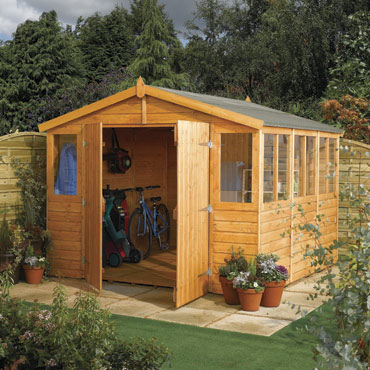
Let’s really explore this process by using an example: Let’s say you know everything there is to know about garden sheds and you want to feature 5 of the best models you’ve found on your site. You plan on generating money from affiliate links (these are commission-based referral links), plus an instruction kit on how to build your own super-amazing garden shed (which you will sell as an ebook with diagrams, lists, workbook, etc.). You may start off thinking that pretty much anyone could be your customer…

But let’s narrow it down. Let’s start by listing who is NOT your customer:

  • Kids
  • Apartment dwellers
  • Condo dwellers
  • People who hate gardening
  • People who are never home and hire someone else to look after their yard
  • People who are renting – *unless your sheds are movable, ah, you need to make this clear, don’t you? Make a note to yourself to include this in your site copy and product descriptions

Now let’s talk about who IS your customer. You might think that your customer is someone who can “afford” a garden shed. But research has shown that people don’t buy what they can afford, they buy what they WANT, or think they need.

I remember a guy who owned a deluxe garden shed company telling stories about his customers who lived in trailers or mobile homes, and they had not one, but TWO of his super deluxe, super expensive garden sheds – that was their priority, it was what they wanted. Because…that’s right, people buy what they want! So don’t even worry about affordability right now. Just assume that your customer will buy if you have what they want and if they have confidence and trust in you.

So your customer could be:

  • Someone who has a garden and at least mows the lawn
  • Someone who has a hobby that requires a shed to store stuff – okay, so here we go, your customer doesn’t need to use your shed for gardening right? So now you need to brainstorm other uses for your sheds; playhouses? Art studios? Tool sheds? Workshops? If you come up with other excellent uses for your sheds, don’t dilute your homepage or take away from your site’s main focus (that will just confuse your visitor), but you could do a blog post about each type of usage and have pictures of the sheds that would work best for that application. That way you will get additional Internet traffic coming to your blog, that you would otherwise miss because they’re not looking for a garden shed, they’re looking for a tool shed!
  • Someone who hires someone else to care for their garden, but has all their own stuff they want used in their garden.
  • Someone who used to be too busy to garden, but is now retiring and ready for a great hobby.
  • Someone who’s read about how ‘earthing’ and getting your hands in soil is good for your health.
  • Moms and Dads who want to cut their grocery budget and grow their own food – lots of resources you could offer these visitors!
  • Someone looking for the perfect Father’s Day gift
  • Someone looking for the perfect gift for their retired parents

Where Does Your Customer Live?

Spend some time thinking about where in the world your customer might live – which countries, regions, climates, language, culture, etc.? Start to build a picture of that target group and the specific environments they live in.

Is your product or service only applicable to your local market? Or do you appeal to people in other states, countries, or continents?

If you realize you have a much bigger market than you originally thought, then it will be worth your while to research shipping to other countries.

Let’s stop there for now. But do you see why it’s so important to really explore who your customer is and get all this info down in writing?

Remember the lesson we learned about the garden sheds: People don’t necessarily buy what they can afford; they buy what they want.


Spend some time thinking about where in the world your customer might live – which countries, regions, climates, language, culture, etc.? Start to build a picture of that target group and the specific environments they live in.

Is your product or service only applicable to your local market? Or do you appeal to people in other States, Countries, or Continents?

Define your ideal site visitor or customer, i.e. WHO are you solving the problem for? Focus on their wants or desires, their feelings, not their needs:


How Do I Write An Elevator Speech?

Once you know:

…then it’s time to distill all of that information into one or two sentences.

Cocktails & Elevators

Some people call this your elevator speech: You’re in an elevator and someone asks you, “So what do you do?” and you have to answer them before the door dings and they get off the elevator.

Other people call it your cocktail party answer: You’re at a cocktail party (or networking event) and you’re just introduced to someone new, they ask you, “So what do you do for a living?” If you give a boring answer, they will either drop the topic, or go find someone else to talk to. If you have a good answer, the person will likely ask you for more details or information – because you have piqued their interest.

Many people are highly resistant to encapsulating their business this way – if that’s you, then it most likely signals that you have resistance to putting yourself out there. So again, are you in, or are you out? If you’re in, then get that pesky little ego out of the way and get your cocktail party answer together. Already have one for your existing biz? You know what I’m going to say! Tighten your belt, wipe the slate clean, do it anyway, and see if any new insights emerge.

This is not so that you’ll have something to say at cocktail parties, or when riding in elevators! Your one or two sentence answer to the question, What do you do? is crucial for these reasons:

  • You need the answer for your website; where you will have 3 – 6 seconds to capture your site visitor’s attention before they click away.
  • You will need it for networking, business meetings, bank meetings, radio interviews, teleseminars, etc.
  • You need it for the person at a dinner party, or on the soccer field, or after church who asks you what you do and just happens to be your next customer.

Make sure your answer to the question, What do you do? includes the benefits or problem that you solve for your customer, not just a dry descriptor.

Rather than saying, “I’m a mortgage broker”, say, “I help people finance the house of their dreams.” You see the difference?

Or how about, “I train horses” versus: “I help horses and owners overcome their blocks and achieve unity.” BIG difference when you focus on the benefit.

It is vital that you know WHO your average customer is and WHAT it is that they want or need before you continue here and start drilling down to create a compelling elevator speech. If you haven’t already done so, the stop here, bookmark this page, and follow these links: How Do I Figure Out Who My Customer Is? And How Do I Offer Exactly What My Customer Needs?. Take a bit of time to go through those processes FIRST on paper, screen, or recording device. Without these answers, you won’t have much to draw on for your elevator speech.

Still with me?

Stories sell because they show you are resonating emotionally with your site visitor. And if you are emotionally in touch with your ideal customer (follow the links above if you don’t think you are!), you will know which benefit they are longing for, or needing to experience.

So let’s make it easy with some some fill-in-the-blank formulas that you can use to create your cocktail party, or elevator speech…


Look back over your notes about who you customer is and what they need or want. Then take the top benefit(s) your customer experiences with you and make those benefits into a descriptive sentence. This descriptive sentence (or two) is going to be your cocktail party, or elevator speech.

Make sure your answer gives the problem you solve, the pain you relieve, or the desire you fulfill. This automatically ensures that your business description contains a benefit to your site visitor.

Remember everything you’ve learned about how and why storytelling sells? This your chance to tell your story, but in speed format, like a trailer for a movie or a summary phrase on the back of a book.

If you’re stuck, use these phrases to kick off your elevator speech. Just write out your answers and fill in the sections in the square brackets [  ] for yourself:

So when someone asks you, “What do you do, exactly?
” You say…

  1. I help [who is your customer] have/reach/get/achieve [benefit].

Example: I help high school grads have the best college experience by finding them the perfect school for their strengths and talents.

OR

  1. I teach [who is your customer] how to [benefit].

Example: I teach dog owners how to have a calm, happy dog by transforming their relationship dynamic and helping them become the Pack Leader.

OR

  1. I show [who is your customer] how to [benefit].

Example: I show realtors how to double their sales and cut their ad budget in half.

OR, a little different…

  1. I connect you with [emotion or benefit] so you can [benefit].

Example: I connect you with your best self so you can live your best life.

OR

  1. I make people’s lives [emotion or benefit] by [benefit].

Example: I make people’s lives more meaningful by connecting them to their true desires.

OR

  1. I give people [emotion or benefit] so you can [benefit].

Example: I give people hope by providing the support structure they need to care compassionately for their disabled child.


Here are some other phrases you can use to kick off your benefit-laden elevator speech that answers the question, What do you do? Now write yours here:


I transform…

I facilitate…

I write…

I paint…

I program…

I enable…

I empower…


Can you think of any other ways to start your elevator speech? Go ahead and brainstorm as many different elevator speech answers as you can (do at least 5!):

1.________________________________________

2.________________________________________

3.________________________________________

4.________________________________________

5.________________________________________


If you find you’re still not crystal clear on how to define your customer or your business, Mark Silver’s workbook What Do You Do? also helps you nail down who your customer is and what problem you solve for them. Right-click to download: What Do You Do?


How Do I Register My Business Legally?

If you haven’t done so already, you will need to choose the name of your company and get it registered – the simplest version of a company is usually called a sole proprietorship, but the term can change depending on your country. You don’t usually need a business license, unless you have a physical location (physical clinic, store, restaurant) as well. And in the early days, you don’t need to incorporate either (which is more expensive), unless you are at risk of being sued.

If you’re unsure which legal business structure will work best for you, depending on your personal tax situation and the country you’re in (Inc, LLC, Pty, proprietorship, etc.). Then either do an Internet search on your options, here’s a good place to start:

http://www.entrepreneur.com/article/77730

or you can get in touch with your local business development center, or government branch that supports small business, for free advice. Or ask your accountant.

For example, the US Small Business Administration has fabulous resources, online training and mentor help (all for free) like this article on registering your business:

http://www.sba.gov/category/navigation-structure/starting-managing-business/starting-business/choose-register-your-busi

STOP right now and read the articles above. Decide which legal entity you will use to set up your business and, if you already have a business, decide whether now is the time to incorporate, or not:

  • a Proprietorship (easiest and cheapest, but you are personally liable for your company if you get sued)
  • an Incorporated company (LLC, C-Corp, Inc. etc., you are not legally liable for lawsuits against your company – unless they can prove personal fraud or negligence)

And while we’re on the topic, here’s a free course on how to write a business plan (if you happen to need one at some point; like when you’re trying to get a bank loan):

http://www.sba.gov/tools/local-assistance?ms=nid3457

But you at least need to get your business name registered as a legal entity and this usually costs less than $100 and can often be done online. This protects your business name from others using it and makes sure you don’t use a name that’s already taken.

Take some time to jot down the answers to these questions:


Are you going to set up your business as a sole proprietorship, or a corporation?


What will be the name of your business (this will appear on people’s credit card statements)?


What do you need to do to register your company – is there a phone number you need to call, or website you need to visit to get the ball rolling? NOTE: Don’t set up your company yet, until you’ve got the domain name for it!

How Do I Plan My Business To Support the Lifestyle That I Want?

As you’re going through the process of defining your business, planning your new website, and thinking about what you want to sell, and how you want to sell it… it really helps to keep in mind your vision of what you’re working towards.

By that, I don’t mean what your finished site will look like. I mean the BIG picture: What do you want your life to look like when your business is up and running?

There’s no point in jumping ahead to decide what you want your homepage to look like, and all the things you’ll be selling on your site, until you’ve defined exactly how you want your business to integrate with your life plan.

There’s no point in setting up a consulting business, where you charge $100/hour, when you can only work 2 hours a day – unless, of course, you’re happy with that amount of money. So before you can decide what you want to sell, how you want to sell it, and how you want to deliver that, you first have to decide what you want your daily life to look like. That way, you can make sure your business services your ideal life and supports you in living an awesome life!

So let’s ensure you’re on the right track and that what you’re planning for yourself really does reflect your goals, values and soul’s purpose.

Kick-start your thinking process on this whole topic by watching this video first:

Sell Your Crap. Pay Your Debt. Do What You Love

Pretty powerful eh? And did you notice how he was very explicit about the importance of defining what kind of life is desirable or meaningful to YOU? Not what other people might value, but YOUR values.

Freedom Is Personal

I think it’s pretty safe to say that all of us want more freedom in our life. The question is: what exactly does that mean to you? Because ‘freedom’ is a personal experience and each of us will define it differently.

For Emma, freedom might mean traveling round the world, studying art and architecture and spending a maximum of 4 hours a day on her business.

For Roger, freedom might mean 3 children, with a wife who loves to stay home and care for him and the kids, while he just focuses on making money.

So it’s really important here to avoid making assumptions or generalizations and really spend some time exploring your soul and connecting in to your deepest desires.


Get your favorite pen ready, or your voice recording device, and let’s begin exploring these concepts.

What does ‘freedom’ mean to you?

Freedom means:

What does ‘balance’ mean to you? When you look at balancing the various joys and demands of your life, what’s the perfect mix of all the elements (work, hobbies, sports, kids, partner, animals, music, art, etc.)…

Balance, to me, means:


Now, defining your broad goals – like freedom and balance – is an important step, but does give you a concrete plan for how to achieve balance and freedom in your daily life?

An important part of being successful is always looking for the way to take large or abstract goals or visions, and break them down into smaller, concrete action steps.

So that’s what we’re going to do next; you’re going to take your important vision of freedom and balance for your life and break it down into a clear action plan for your daily life.

A fun and easy way to do this is to ask yourself:

What does my PERFECT DAY look like?

If we just stick with global, or general questions, we’ll end up with lofty statements and beautiful visions, but our day-to-day reality will not change. And we’ll still be chasing some version of the carrot on the stick.

When you finish reading (or whenever you will have a quiet space), you’re going to write down (or audio record) what your ideal day would consist of.

You’ll start with whatever time you would wake up (I might like to wake up at 10 am, you might like to wake up at 6 am) and then you will plot your ideal day in one-hour increments, labeled with what you would like to be doing in each of those time slots.

YES you need to get that detailed! Because when you get into the nitty-gritty, of each hour of your perfect day, the flaws, or incongruence in your big vision will be revealed.

Then you will have the chance to rectify the inconsistencies and come up with a cohesive vision that is truly authentic and that you can actually begin to implement.

For example, let’s say your vision for your perfect day consists of 2 hours of yoga, 5 hours of cooking and childcare, 2 hours of TV and 1 hour in a soaker tub… but yet you’re setting up your site to generate income from private consulting sessions where you charge $60/hour. So that’s 9 hours total of yoga, cooking and TV, and probably 3 hours of consulting for a gross revenue of $180/day, which means $900 per week, and $3600 per month. Then you will have some admin, accounting etc. work on top of that every week or so.

If you’re a Dad with 2 or 3 kids and your wife has a good paying, steady job, this would probably be decent money for you (after taxes and expenses). However, if you have a toddler and your wife has just given birth (so will not be working anytime soon), setting up your business this way is unlikely to meet your needs, let alone your desires. In a case like that, the incongruence between what you want and what you’re actually doing or planning for is going to result in you feeling unhappy and frustrated – and financially struggling.

Phase 1, 2 & 3 of Your Perfect Day

And of course, life is not fixed. Situations change all the time. So maybe you cannot achieve your ideal day in your first month, or year of your new and/or improved business. In that case, you would write down two or three different examples of your perfect day. You would do one Perfect Day outline for the set-up phase of your new business, or for the transition phase of your business expansion or re-design – for the first 3 months or so, for example. Remember, this may still include your day job – full- or part-time – or whatever you need to do to stay financially stable enough to support the nurturing of your dream projects.

Then do another Perfect Day outline for the growth phase of your business – the next year, for example.

Then do a third Perfect Day outline for years 2 – 5 of your business or new direction, when everything is settled and you’re steadily moving forward.

Breaking down your day into clearly defined one-hour slots will not only help you manage your time, it will help you plan your business effectively – to be able to deliver and support the lifestyle you want. It will also enable you to plan out a road map for staying balanced and healthy while you start or expand your business.

Remember, Listen To Your Freedom is not about working like a dog for 5 – 10 years so you can make tons of money and eventually enjoy your life! It’s about designing a life that supports you emotionally, spiritually, physically (health) and financially in a balanced, enjoyable way.

Jini’s Perfect Day

I re-do the Perfect Day exercise every so often, especially when I feel frustrated, or out of balance. The first time I did this exercise, I did two different versions – just to help me define my desires and my parameters better. I mapped out one Perfect Day pretending I was married, but had no kids. Then I mapped out another Perfect Day for the life I actually had – wife and mother of three children.

Why did I do that?

Because as soon as you have extra beings in your life that require your care – kids, animals, an aging or sick family member – the map of your day changes significantly. So I found it valuable to first map out a Perfect Day with no kids in it. This enabled me to really plug back into my core self, to get out of mom-mode (where I tend to put the kids’ needs first) and plug into my own soul’s desire, my own physical and emotional needs.

Once I had mapped out my perfect kid-free day, I was able to see my core self and my soul needs more clearly. And then after that I did a realistic Perfect Day map; one that included my children and all the demands of my real life. Some of you may need to get rid of your spouse too, in your first perfect day map, if you tend to take care of their needs before your own.

Mapping my perfect day in this manner led me to make some changes to our family’s way of operating. I set up certain systems differently and reassigned some responsibilities. For example, I taught the kids a repertoire of foods they could make for themselves for both breakfast and after school – thereby relieving me of those repetitive, energy-sucking (for me) tasks.

I started weekly menu planning with them (I have a couple of really picky eaters) for suppers and established that 2 meals per week would be crock-pot (slow cooker) meals to cut the work load on the days my daughter had gymnastics and needed to eat supper at 3:30 pm.

We rearranged the bedtime routine with the kids and my husband and I re-scheduled things so we both got more workout time.

Mapping my perfect day also made me realize that I wasn’t doing enough of the activities that fed my soul and my creativity. Some of the things I wanted did not exist, so I set up my own Art (painting) Group, my own Bookclub, and persisted until I found the perfect yoga class (my former yoga mentor had retired), and an awesome Pilates teacher.

On the work front, I was already pretty organized about delegating, or outsourcing, anything other than new product creation, but by actually mapping my day hour-by-hour, I realized that replying to my blog and Facebook comments was now taking up a good chunk of my time; but even more of my mental space. By the time I finished answering the blog comments, my focus was fragmented and I had less energy for new product creation.

I also realized that answering emails left me in the same state; with fragmented energy and less focus. So I decided to not even look at my emails until the last 45 minutes of my work slot. If I couldn’t get to all of them in that time frame, I could squeeze them in here and there when the kids were home and occupied with their friends or sports. I delegated all the Facebook and blog comments to my assistant and instructed him to only tag me to answer a comment if he couldn’t, or if he felt I could add significantly to his answer. I have lots of other holistic time- and energy-saving routines and hacks for you to experiment with.

Again, these insights only came about because I went through the process outlined above and actually wrote down an hourly breakdown of my perfect day – one with kids and one without.

Your Perfect Day Maps

Now it’s your turn. Do each of these Perfect Day maps – even if it doesn’t make sense to you – and by the end I guarantee you will have some significant insights about what you want, and what you need to do to make that happen…


Perfect Day – Biz Flourishing & NO Dependents

This is what my Perfect Day looks like (in 1-hour increments, from the time I wake up), with no dependents, and my dream business flourishing:


Perfect Day – Biz Flourishing & Real Life Responsibilities

This is what my Perfect Day looks like (in 1-hour increments, from the time I wake up), with my existing family and responsibilities, and my dream business flourishing:


Perfect Day – Biz Start-Up

This is what my Perfect Day looks like (in 1-hour increments, from the time I wake up),
with my existing family and responsibilities, and my dream business in the start up or development phase. Remember that most of the work is in the set-up, so if you have a baby or toddler, this phase will last far longer for you than for a single person, because you just won’t have the same time to dedicate to your business. Be realistic:


Now that you’ve done all three maps… Did you learn something new about yourself?

Did you discover some desires you didn’t know you had, or, weren’t giving yourself permission to have?

Are you much clearer now about how you want your life (including work, family, hobbies, health) to look, in order to provide yourself with the freedom and fulfillment that your soul yearns for?


Write down the things you realized and the things your soul yearns for – and then write down here the things you need to change or reorganize in your life to achieve your Perfect Day for this stage and phase of your life: