 Crowdfunding is a way to utilize the financial power of a ‘crowd’ rather than just trying to find one individual, or company, or bank to finance your clearly defined project.
Crowdfunding can be used to finance a large variety of projects, from political or health documentaries, to music albums, to yoga outreach classes, to new inventions, to fashion, food products or cookbooks, games, book publishing, etc.
The only stipulation for a crowdfunding project is that it must be very clearly defined; both in scope and results.
Crowdfunding is a method that allows startups and individuals to raise money from small investors, fans, friends, family and anyone who is referred via your Facebook page, Twitter, Pinterest, Instagram, your blog, email campaign, etc. You can use any combination of these social media tools to drive potential backers to your crowdfunding page, which can be hosted at a number of different sites, like these:
- Kickstarter.com
- Rockethub.com
- Causes.com
- DonorsChoose.org
- Indiegogo.com
- Rally.org
- Crowdrise.com
- GoFundMe.com
Each of these crowdfunding sites has a different slant on which projects they prefer. Some lean more toward political or civil causes, others towards the arts, or technology, or teaching projects. So visit all of them and see which one fits with your project the best.
Some of these sites require you to obtain pledges for the complete amount you are asking for, within a certain time frame, or the funds aren’t released and the project is cancelled. Sites that do this, like Kickstarter, say this method works best because it creates urgency and motivates people to pledge their donations quickly, as well as protecting both parties from attempting to implement an under-funded project.
Other sites, like Indiegogo, do not have these restrictions. In fact, Indiegogo offers you the option of holding a Fixed campaign, where you must meet your fundraising goals, or a Flexible campaign, where you keep whatever you raise.
GoFundMe even allows you to fundraise for ANY reason – including medical bills, your wedding, animal rescue projects, etc. So take a look at the crowdfunding sites given above and pick the one that best suits your needs.
Note: All of these crowdfunding sites (given above) are also supported by YouTube – except for GoFundMe. This means that you can embed a link to your fundraiser page right in your video, onscreen: “Click here to visit my fundraising page and help me out”. Go to the Annotations section in YouTube support for clear, easy instructions on how to do this.
What Makes A Campaign Successful?
There are a number of elements that need to be in place for a crowdfunding project to be successful, aside from just being able to get people to visit your crowdfunding page.
Each of the crowdfunding sites listed above has guidelines, FAQs, or tutorials to give you the knowledge and tools you need to carry out a successful campaign. Since they are taking a commission from your revenues generated, it is very much in their interest for you to succeed.
I suggest you go to a few of these crowdfunding sites and have a look through a few of their most successful campaigns. All of them feature their top projects for you to study and see what common elements make for a successful campaign.
You’ll probably notice that all successful crowdfunding projects have these elements in common:
- Very well organized and laid out, so backers can judge how realistic the project’s goals are.
- Clearly explained objective, purpose and steps to achieve that; with a clear beginning and end. The good campaigns use sub-titles to break up their text and communicate clearly what each section is about.
- The person launching the project is completely sincere and talks to potential backers in his/her own style and language.
- Excellent photographs or video to provide a strong visual of who they are and what they want to achieve with their project.
- All of the above combine to give the backer a clear idea and feeling that the project creator has the ability to complete the project as described.
- Pledges start very low (often $1) and as they increase, they offer good rewards that backers would be glad to receive and that are directly related to the project.
Currently on Kickstarter, the most popular pledge amount is $25 and the average pledge is around $70. Small amounts with a free reward (a gift) for donating yield the best results. Projects without a reward at the $20 level or less, succeed only 28% of the time. But projects with rewards set at $20 (and lower) succeed 45% of the time. Many projects start their pledge amounts at only $1 and then begin offering rewards at the $10 mark.
When deciding what to offer as your rewards, offer something of value. Actual value matters more than just retail sticker price. For example, if you offer a reward that’s a limited edition item, or a one-of-a-kind experience, then there’s a lot more flexibility in setting the reward dollar value, based on your audience. But if it’s a manufactured good, then it’s a good idea to stay reasonably close to its real-world retail price.
Every project should be as creative and true to itself as possible. Put yourself in your backers’ shoes (the people you are asking to back you): would you drop the cash to support your project? And are the rewards motivating enough to help you say ‘yes’? The answer to that question will tell you a lot about your project’s potential.
Another way you can test whether your project is strong enough, is to search whichever crowdfunding platform you chose, for a project that YOU will support. And then actually DONATE to it – go through with all the steps involved with pledging your money to support that project. After you’ve done that, break down the project fundraising page into the elements that convinced you to part with your money. Now make sure your fundraising page has all those things too.
The added bonus to this little exercise is not only are you putting out what you want to get back, but you are now in the autoresponder email sequence for that project. So you can see how the person reaches out to you AFTER the ‘sale’ and how they communicate with you to honor the relationship after you’ve given them money. And of course, swipe away! Copy anything you like and customize it for your own project.
How about you? Have you ever thought of utilizing Crowdfunding to raise money for a project, or product you want to create?
Explore your ideas in your notebook…
Crowdfunding can be a great way to raise money for a project, or product you want to create. Is there anything you’d like to offer the world that could be created faster if you had some funds? Brainstorm your ideas here:
If you’re ready, draft your own crowdfunding proposal, along with sub-titles to answer reader’s questions, and the rewards you can offer to supporters (don’t forget to highlight the different sections of your proposal):
Here are some great examples of types of projects on Kickstarter that work well for crowdfunding and also how each of them set up their project page to be clear, inspire confidence and make it easy for fans, friends and family to contribute.
Please go and visit each of these examples live, so you can see how and why they were successful. Feel free to swipe the way they have organized their pitch, or presented their content.
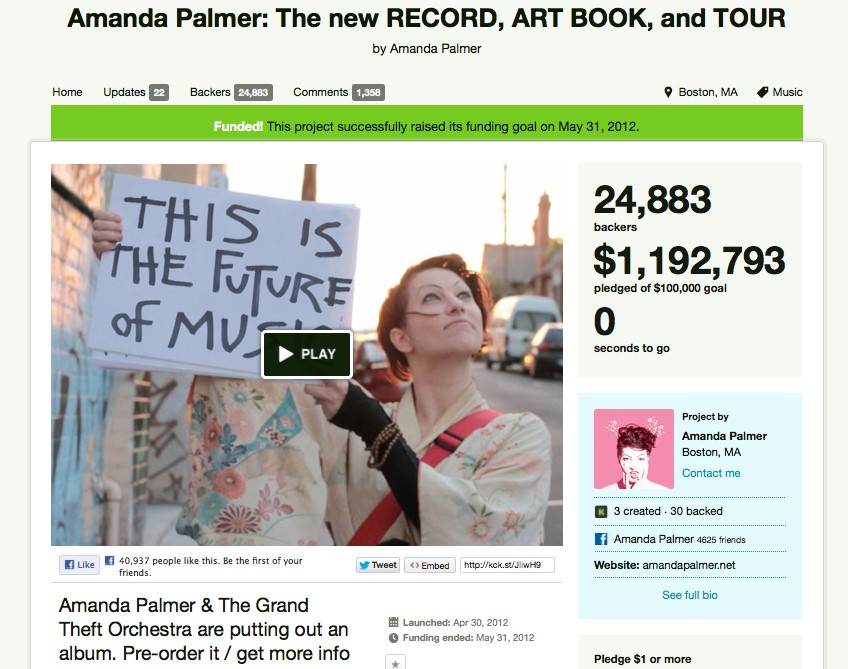
Amanda Palmer: The new RECORD, ART BOOK, and TOUR
Goal: $100,000
Pledged: $1,192,793
Singer/songwriter Amanda Palmer spent four years writing a record and putting her band together. Formerly part of the Dresden Dolls duo, Palmer broke away from a major record label to do her own thing. The album, supported by Kickstarter, was the first million-dollar music project on the Kickstarter platform. The album debuted in the top 10 of the Billboard Charts a few months later.
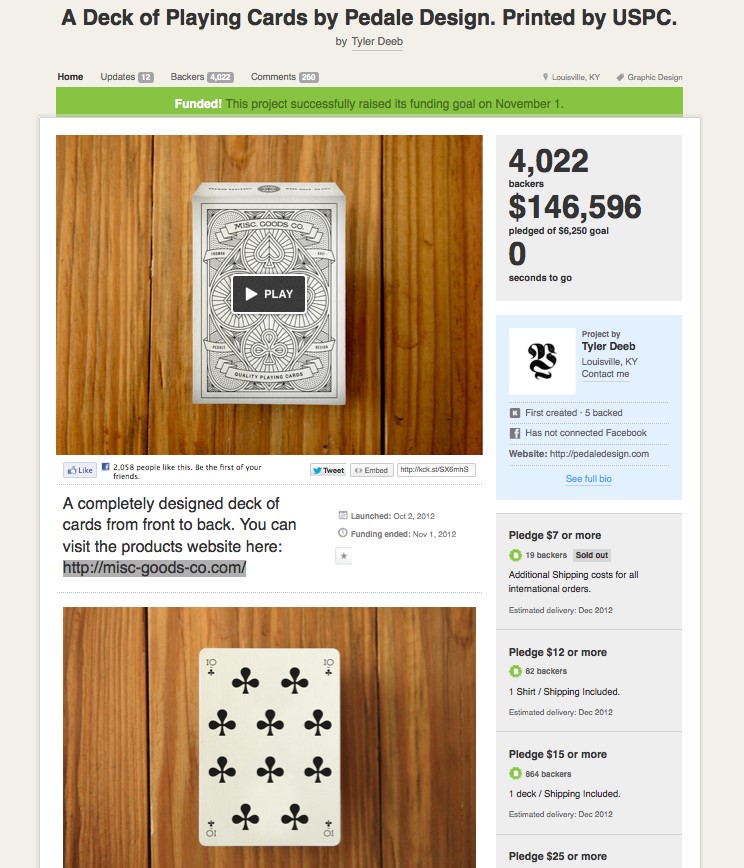
A Deck Of Playing Cards by Pedale Design
Goal: $6,250
Pledged: $146,596
Graphic designer Tyler Deeb’s project on Kickstarter is a perfect example of someone turning two of his skills and interests into income. Tyler wanted to design (he inked each playing card by hand) his version of a gorgeous deck of cards. He is also a card player who was bored with the same old deck of cards every time he sat down to play.
Points to note about Tyler’s project are that he presents top quality photographs of a number of the finished cards – showing he can actually deliver what he is promising.
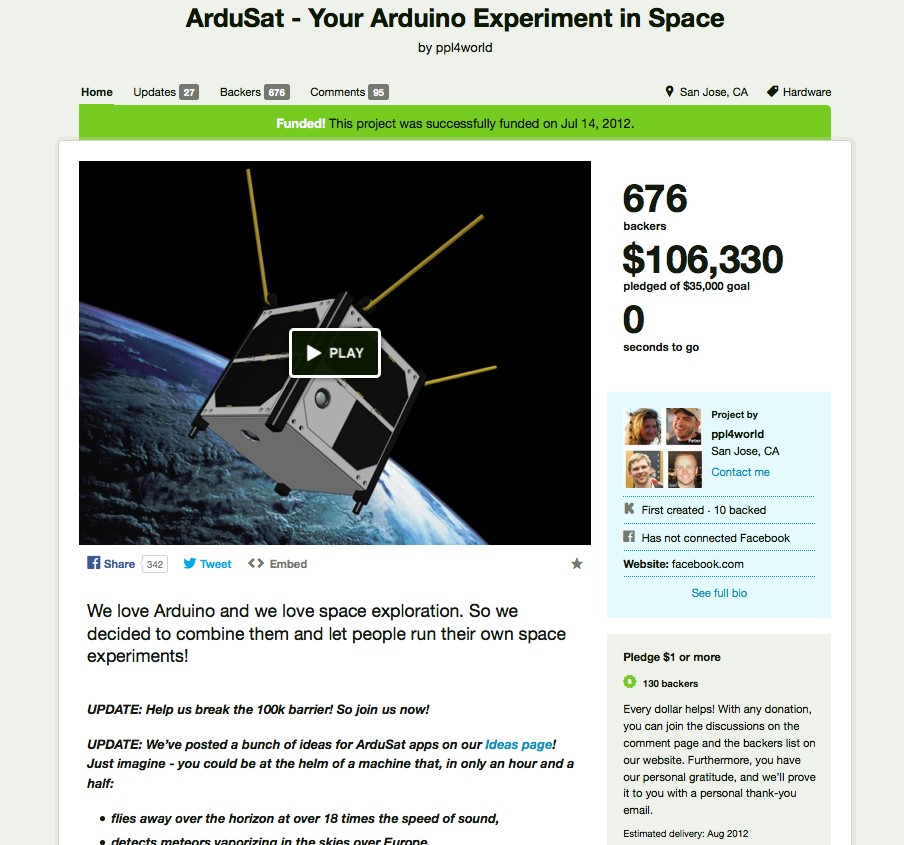
ArduSat – Your Arduino Experiment in Space
Goal: $35,000
Pledged: $106,330
ArduSat is a tiny satellite that weighs no more than 1kg, but it has made a huge impact on the future of space research. Created by NanoSatisfi, this Kickstarter project went well beyond its $35,000 goal in just one month.
The project has democratized space exploration, making it feasible for anyone to run his own space experiment, depending on how many pledges he gets.
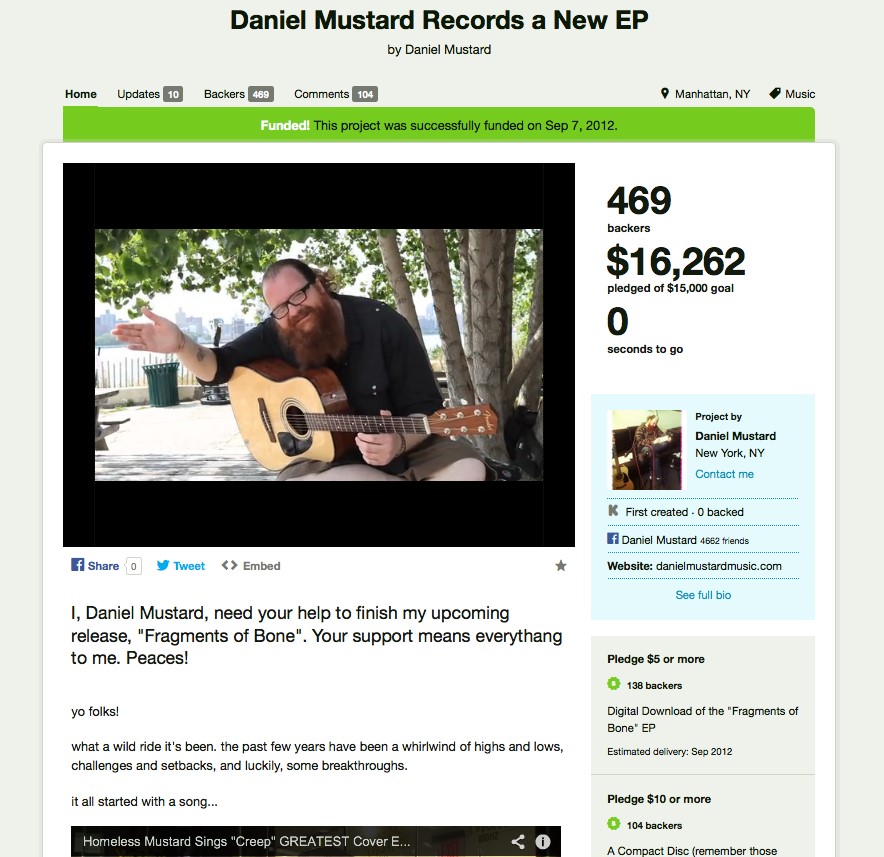
Daniel Mustard Records a New EP
Goal: $15,000
Pledged : $16,262
In 2009, when Daniel Mustard was homeless, his cover of Radiohead’s “Creep” went viral on YouTube. Mustard told Mashable the exposure gave him back his will to live.
Mustard lauched a Kickstarter project in July to pay for the cost of producing and distributing an album. Most of the songs were inspired by his tribulations. The musician is no longer homeless, having found temporary access at shelters and using the Internet to mingle with fans at Apple stores.
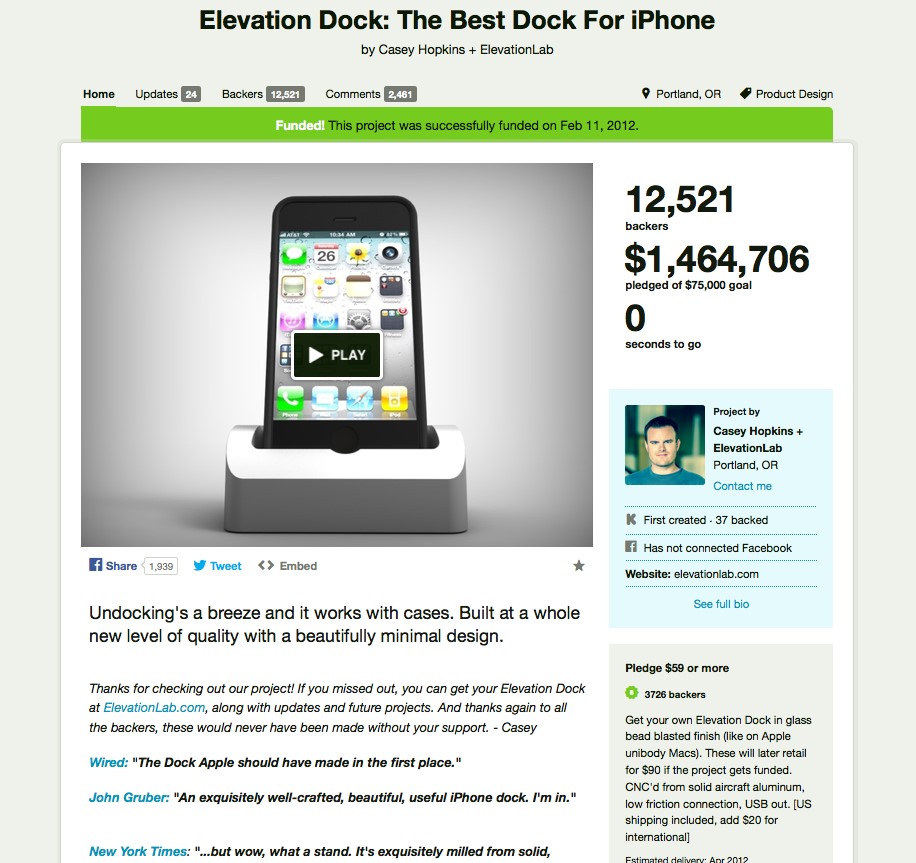
Elevation Dock: The Best Dock For iPhone
Goal: $75,000
Pledged: $1,464,706
The Elevation Dock was a simple concept with one main mission: to make docking an iPhone as seamless as possible, especially when the device is in a case.
This was obviously a common problem among iPhone users. Designer Casey Hopkins and ElevationLab were the first million-dollar project on Kickstarter. And the dock set the bar for high-quality craftsmanship.
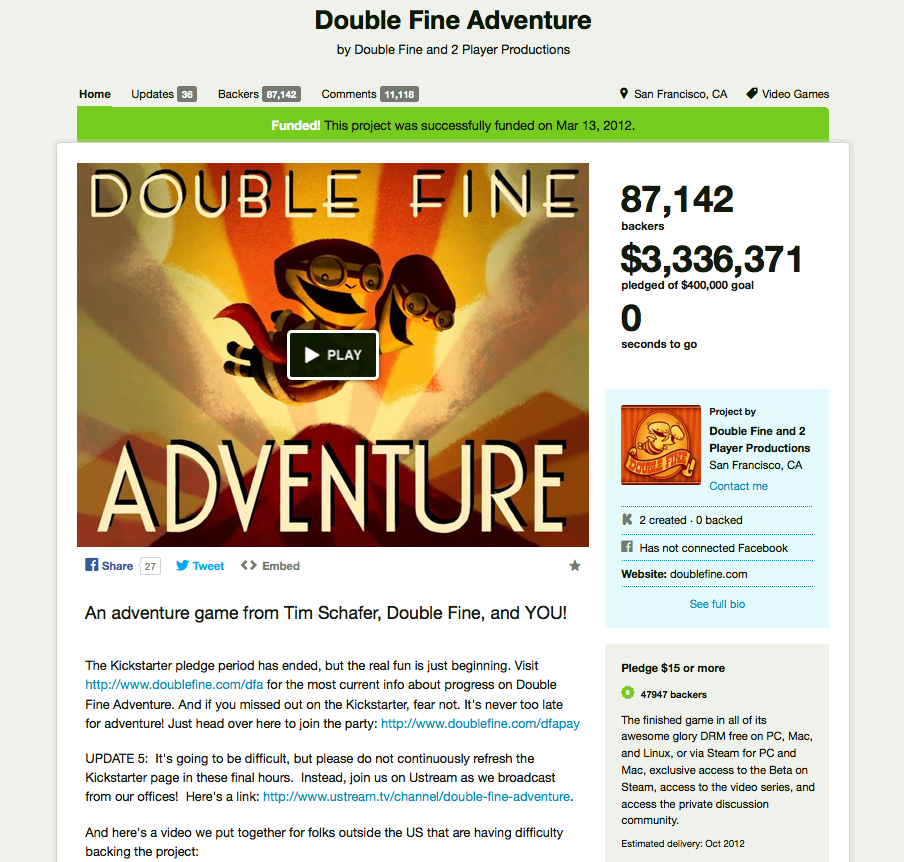
Double Fine Adventure
Goal: $400,000
Pledged : $3,336,371
2012 was a particularly groundbreaking year for gamers on Kickstarter. One of the most important projects, Double Fine Adventure became the first multi-million dollar video game campaign.
The game reached its $400,000 goal in less than 24 hours, making it one of the fastest-funded projects on Kickstarter. Gamers suddenly realized their ideas were viable, and more campaigns like the ones for OUYA and Shadowrun Returns had the opportunity to shine.
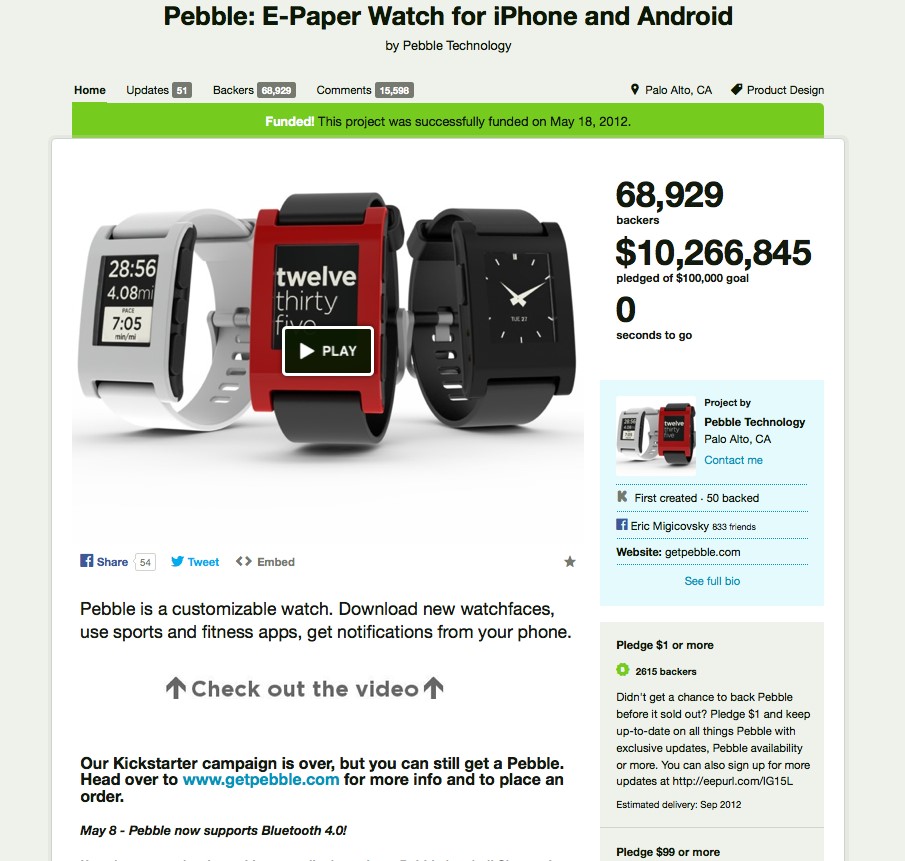
Pebble: E-Paper Watch for iPhone and Android
Goal: $100,000
Pledged: $10,266,845
An iPhone-friendly wristwatch, another seemingly simple concept, nonetheless blew up overnight. The makers at Pebble Technology had a modest $100,000 goal, but reached $1 million in a little more than a day.
These Days: A Novel
Lastly, here’s a Kickstarter campaign from Jack Cheng asking people to fund the publishing and printing of his first novel. It’s a great guide to use in terms of how to present and organize your text – which I will paste below for you to see…
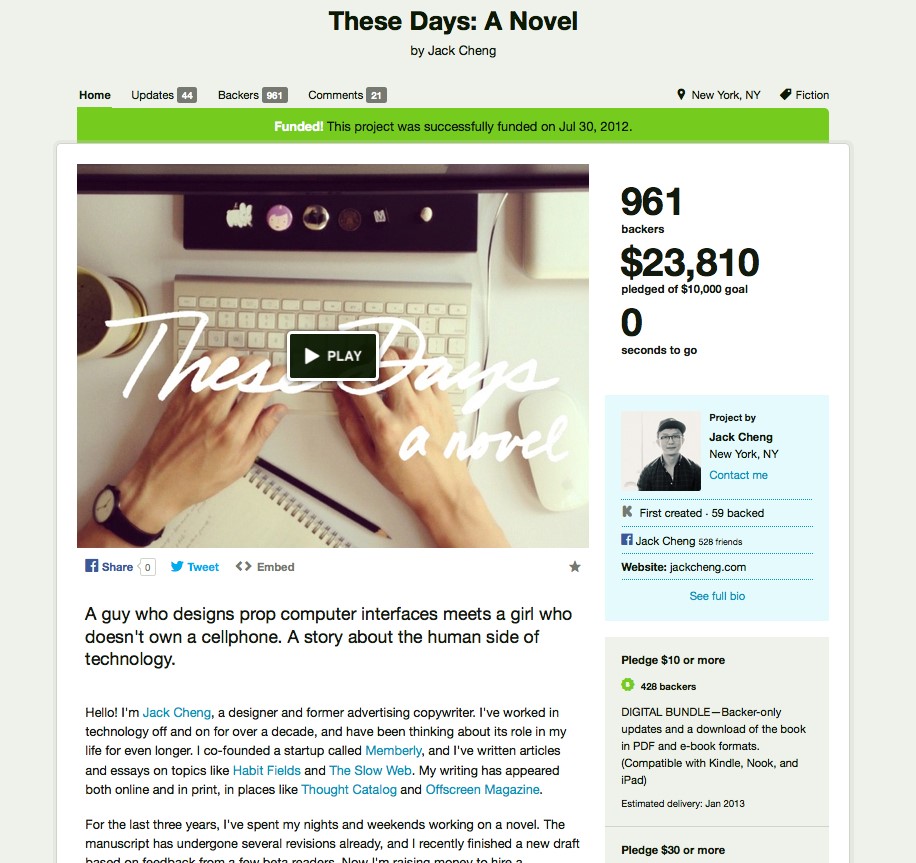
Here’s Jack’s copy from his fundraising page. I’m including it here as it’s a very good framework to swipe and adapt to your project. Note how he uses sub-titles, bullet points, speaks from his heart, and includes all the details a backer would want to know:
A guy who designs prop computer interfaces meets a girl who doesn’t own a cellphone. A story about the human side of technology.
Hello! I’m Jack Cheng, a designer and former advertising copywriter. I’ve worked in technology off and on for over a decade, and have been thinking about its role in my life for even longer. I co-founded a startup called Memberly, and I’ve written articles and essays on topics like Habit Fields and The Slow Web. My writing has appeared both online and in print, in places like Thought Catalog and Offscreen Magazine.
For the last three years, I’ve spent my nights and weekends working on a novel. The manuscript has undergone several revisions already, and I recently finished a new draft based on feedback from a few beta readers. Now I’m raising money to hire a professional editor and publish the book in a range of formats.
Synopsis
These Days is about Connor Vast, a guy who designs fake computer interfaces for plastic prop displays in furniture showrooms. He meets a girl who doesn’t own a cellphone and is as disconnected as he is connected. As their relationship develops, he falls in with a group of entrepreneurs out to invent the future, but it’s the same future she’s rebelling against. It’s a story about the human side of technology—the people who make it, the reasons they build, and the people on the other end.
Length and Sample Pages
The current draft is approximately 250 pages. You can read an unedited sample of the first four pages here.
Where the Funds Will Go
Your backing helps me do two things: it helps me make the book better, and it helps me get the book into the hands of the right readers. I don’t have the resources of a big publisher, but that’s not a bad thing. It just means that the constraints are in different places, and it’ll take some ingenuity and a startup-like mentality on my part. It also means your support is crucial to making These Days a success.
More specifically, your backing helps me with the following:
- developmental editing
- line and copy editing
- proofreading
- allow printing in bulk to bring down the per-book costs
- purchase of fonts and other design assets
- obtaining ISBN numbers, paying registration fees, and additional costs associated with getting listed in various online bookstores
- envelopes, packing materials, postage
- extra copies in case of “breakage” (those that get lost in the mail, etc.)
- extra review copies
I’ll be detailing the entire process via backer-only updates along the way.
Why I’m Printing a Physical Book
For all the distances we travel between the pages of the book, the physical object itself is a souvenir of that experience. Like all souvenirs, the object is a memory device, so that when our eyes glance over the cover on our shelves, we are pulled momentarily and subconsciously into these past worlds and emotions. The nicks and creases and tea stains that patina the object over time further ground it in our memories, reminding us of where we were when we read the book, what we were doing, who we were with. The object is a conversation hook, an invitation to friends who stop by before going out on Friday night, and strangers you meet on the train in the sweltering New York summer. And the object is a ticket to return, a ticket that never expires.
I buy physical books. I buy e-books. Both have their advantages, but I believe that at this moment in time, a physical book is still a vastly superior interface for the stories I cherish. These are the books I find myself reading over and over again. These books have hard covers but they are also soft and yielding—they are forgiving to our different ways of highlighting and annotating. They can be dog-eared and marked up and still work when you drop them. They may not have search boxes, but their contents are imminently discoverable, especially when you’re not sure what exactly it is you’re trying to find. And they never run out of batteries.
My goal for this project is to tell a story worth cherishing, complete with an artifact—a souvenir—appropriate for the experience.
– –
Video credits: the background music is “Lattice” by Darren Harper. Nearly everything was shot on an iPhone.
The examples I’ve given you here show how you can use crowdfunding to finance a wide variety of projects – rather than trying to get a loan from a bank, or putting everything on your credit card.
I’ve also seen many crowdfunding campaigns for much smaller amounts, like $500 or $1000.
Just remember, you need to have a very clearly defined, specific project to be able to use crowdfunding. You can’t use crowdfunding to pay your rent, or buy real estate, or sell equity, for example – although remember that GoFundMe has very broad parameters of what’s allowable.
Each crowdfunding site has its own specific guidelines as to exactly what they allow and what is not allowed – so be sure to read through these guidelines when choosing your crowdfunding platform.
If you think crowdfunding would work well for your project, but you’d like more specific guidance, or, you’re going to be fundraising for a large amount, then you may want to hire a specialized crowdfunding coach, like Kat at Multitude.
You can also make use of Kat’s excellent free tutorials on every aspect of your crowdfunding campaign, like this tutorial that gives you all the do’s and don’ts of your crowdfunding video.
As you can see, crowdfunding is an awesome way to generate the money you need – IF you have the right approach and want to put this specific kind of effort in. But if you don’t feel that crowdfunding is going to work for your particular project, or if you’d simply rather fund it another way, stay tuned for the next three units. I’ll tell you some of my very own tried and true secrets to getting the money you need – even when it looks impossible!
Have these examples sparked any new ideas for you? Make sure you write them down in your notebook!
 In this audio, I talk with Ian Thompson about how credit can actually be your friend – if you use it very, very wisely. With these tips, you can take advantage of credit companies’ Special Offers, and never pay regular high interest rates.
 Click here to download the audio (right-click and Save As):
Recent Comments