How Do I Know What I’m Getting Myself Into??

Hang on – all this planning is super fun, but where is it going? Do you really want an internet business? Do you know what that entails?

I bet some of you have some burning questions about what we’re doing, what it’s going to look like, and how it all works. So let’s telescope out and take a look at the big picture for a moment, so you can get some clarity on where LTYF will take you – because there’s needs to be a solid platform for all this freedom you’re going to generate. Let’s start with this: How exactly does a website or a blog make money??

Where Does “Internet Money” Come From?

You’re here, so I know you’re game, but sometimes new Freedomites admit to being more than a little overwhelmed when faced with moving operations towards being online and automated.  It all depends on what your experience in business has been up until now. If you’re feeling a little uncertain of what you’ve gotten yourself into, let’s break it down to basics and see where you’re at.

Right now were seeing a zeitgeist of people who are making an honest living through online business. The cool thing is, I bet you’ve visited, or followed, some of their sites and not even realized it was their livelihood, because it can be that subtle and non-invasive.

So if you want to know how they do it, look closer. Start looking at websites and blogs with a new awareness. Ask, could this site be making money? Look for clues that might give it away. Do they have a shop? A sign-up box for a newsletter or some kind of freebie? Do they review products or tell their readers about particular workshops, teleseminars, or programs? When you buy something online, think about why you’re buying it. What made you decide on this product, from this site?

As you progress through LTYF, I promise it will all become more clear. You’ll start to see the potential for money in the strangest things – even if you’re already well-versed in online commerce!

So back to “internet money”  – the stuff I’m promising you in this program. Let me set something straight for anyone with lingering doubts: it’s not a scam, it’s not magic, and it’s definitely real money.  Let me explain in detail…

There are basically three streams of “internet money” that we’ll get into in LTYF:

1. There’s advertising, which is obvious from the amount of advertisements you can see all over websites. I mention it first only because most people assume it’s the main thing that generates cash on the internet – which is not true in our case! Ad revenue is great to know about, but it probably isn’t where the bulk of your income will come from, at least not for a long while. But if you’re curious about making money from advertising, check out this page.

2. Then there’s sales from your own products and services, which is what we’ll focus on throughout much of LTYF. I’ll give you tons of ideas and tutorials on how to design and create your own valuable products, both physical and digital, and show you how to produce, market, and deliver them to your customers. Believe me, there is something you can sell on your site, no matter how weird or niche-y it is. In fact, the more specific you get, the more you’ll attract a core group of enthusiastic and loyal customers.

3. Affiliate sales are a less obvious, but really fabulous way to generate income, either on the side or as your main venture. This is accomplished by making a commission when you sell someone else’s product through a link on your site. Whether you’re reviewing a great product, recommending a book that changed your life, or telling people about a workshop you’re really excited about, you can make considerable commissions on anything people take your word for and purchase. The great thing about this revenue-generation method, is that you can do it from an authentic and helpful place without being “selly” at all.

So where does the money come from in an affiliate sale? Think about when the owner of a physical store sells a product – when they mark something up from wholesale to make a profit, they are essentially receiving a commission for each product they sell, sometimes over 50% of the wholesale price. As an affiliate, you get to act as the salesperson and earn that commission on anything that sells through you, but without the hassle and cost of warehousing, shipping, or even touching the product!

We can go over all of this in detail, but for now, keep in mind that entrepreneur Pat Flynn makes over $40,000 a month on affiliate sales alone – with a blog that talks about affiliate and other “passive” income! Pretty darn cool!

And if you still think it sounds fishy, and are still wondering where all this internet money is coming from, think about all the middlemen that can be cut out of a more direct economy. Each of them has to be paid out of the ultimate price of the product – so the fewer hands in the pot, the more money is freed up to flow to you!

Those are just some examples to get you moving around the idea of internet money or automated income. We’ll cover all the juicy details when you’re ready for them, but is this floaty concept of “internet money” getting a little more real now? Like I said, it’s not magic, but it can still feel pretty miraculous, even to me!

What is “Passive Income”?

Both affiliate and advertising income are often referred to as passive or automated income, and even your product sales, especially the digital ones, can fall into this category. I prefer the term automated, as the term passive suggests that you don’t have to do anything to earn the money. But you do – it’s just that once you’ve set up the automation infrastructure and know how to point people in the product’s direction, you can make money without having to trade time for wages, or a physical product for cash, because the system you’ve set up is taking care of all that. As with most of what you’ll be learning in LTYF, the work happens in the set-up. So, in my view, it’s not passive at all, but it’s still a fantastic improvement on the old “time for money” model – and it may be the ticket to your success.

So…Tell Me Again, Why Online?

WorkingYou’re probably starting to understand some of the benefits of selling online from what we’ve just talked about. But I’d just like to say this: everything you learn in LTYF comes from my own personal experience and years of experimentation and testing since 1997.

The details of online business may change as the internet grows and develops, but the core principles I am teaching you will stand up in any arena – and yes, once you get the hang of it, you could easily, with a little creativity, transpose them into “real world” situations. These core principles of LTYF – or of building a thriving business built on your passions – are actually very simple.

They’re about:

  • building an authentic brand that you yourself believe in
  • offering quality products that you’re excited to share with the world
  • creating excellent relationships with your team and your customers
  • having your business be known and easy to find
  • providing great, consistent service that your customers can trust, and
  • creating systems that are not only sustainable, but ultimately regenerative.

Even simpler, it’s about being YOU, expressing that effectively, gathering a tribe of like-minded people, and caring for them so well that they are happy to return all your efforts with the energetic exchange of money. And, maybe most importantly, it’s about doing all this as efficiently as possible so that you have the time, energy, and resources to keeping shining your light.

We are living in a time where virtually anything is possible – for anyone, from anywhere. The Internet makes running a business just incredibly faster, easier, and wider-reaching. Your products and services can be produced and distributed quickly and cheaply. Running your business with as much automation as possible can save you hours of your time. Outsourcing will save you money you’d otherwise have to spend on staffing, and people all around the world can access what you have to give.  Not only that, but you can niche down as far as you like and you’ll still be found by hundreds and thousands of people looking for what you’re selling.  Whereas, once upon a time, your customer base could only be drawn from the handful of people who could physically access you, now you can reach anyone, anywhere, so long as you have what they need or want. And I’m going to show you how to set up your site – using simple procedures – so that search engines will rank you higher and your site will be at or near the top of the list when people search for stuff related to your product or services.

What Will I End Up With?

When you’ve worked your way through this whole site and implemented everything that applies to your business, you will have a fully operational WordPress website (or a WordPress blog added to your existing site) up and running that will:

And, of course, if you don’t know what some of this means, you will know it inside out and backwards by the time we’re done. This site is designed to fill you up with all the info, resources, and know-how you’ll need to build, maintain, and master all of this and more – but all on your own time! You’ll have the tools to make it as small or big as you want, to require as much, or as little of you as suits your lifestyle, and to provide you with whatever your vision of freedom is. With your membership, you can take all the time you want – or speed through it and come back again and again each time you want to launch a new product, or a new business.

Whew. That’s a lot of info to take in, but remember it will all come one step at a time, at your own pace. So that’s the big picture. Now let’s zoom back in to where we’re at – the beginning. What would you most like to learn next?

How Do I Come Up With a Business Idea?

It’s one thing to decide you want to run your own business…and it’s something else entirely to know exactly what that business is going to be! Likewise, it’s easy to dream about “one day”, but picking a starting point in order to get to that destination is a little trickier.

At this stage, it’s really important to take some time to discover your WHY – your foundation, your guiding light, your raison d’être. Once you become clear on that, the next steps will take shape before your eyes. You’ll begin to see how your purpose, passion, and income can all come into alignment so that they can all fuel each other, and create the business of your dreams.

Your Top Talent

Together we’re going to explore what makes you unique and I’m going to help you define your top talent. I’m also going to suggest some resources for you if you’re really unsure about your direction and need some in-depth exploration.

Do NOT rush this stage of the process! It is far better to take the time and effort to define what it is you want in the beginning, than to set up a business and have to change it all later because you realize that’s not actually what you want to do! Or, that although you want to do X, or already are doing X, you haven’t come up with the best way to position yourself, or offer X to your potential customers.

This is not something that anyone else can do for you, or give you the template for! It can only come from you – your desires, your dreams, your passions and interests.


So grab a notebook and take some time to answer these questions as honestly as you can:

 What do friends or family say about you – what do you often hear them repeating? (Note: If you can’t think of anything, go to 5 friends or family members and ask them: What are the 3 best things about me and what are the 3 worst things about me? Then write their answers down.)

 What do people always ask you to help them with?

What do people often ask your advice about?

What are your top 3 interests, or hobbies – what do you read books about, take courses in, spend time doing, or really enjoy doing?

 What could you talk about for one hour with no problem?

 What do friends and family say you’re really good at? (Note: Again, if you can’t think of anything, go to 5 friends or family members and ask them: What are my top talents, what are the three things I do best? Then write their answers down here)

 What do you wish you were really good at, or better at?

 If money was not an issue, what would you spend your days doing?


Now go over your answers to all those questions. Look for any common or repeated elements. Which of those things leap out at you? Which things make your heart sing? Distill it down further into your top 3 talents, skills or interests. The top three things you have to offer the world, or are passionate about, or good at, or interested in.


Your Top 3 Talents or Interests:

1._________________

2._________________

3._________________


Turning Talents Into Income

Are you inspired and excited, or nervous and apprehensive, or a little of each? Now that you’ve nailed down what your top three talents are, you may be wondering: Fine, but how do I turn these talents into money? Or, if you’ve already built a business or blog around your top talent, maybe you need more ideas for how to monetize (generate revenue) from that talent, skill or interest…

I didn’t start out as a health expert – I lived the journey, and I shared as I learned (and still do!). What did I do to kickstart my business (though I didn’t know that’s what I was doing at the time)? I wrote a book. I wrote down everything I could remember about my intense, seven year recovery from Chrone’s disease, and I published it as an eBook. That’s all I had time for (I was raising kids and breastfeeding babies – I just wanted the information to be out there for whoever needed it). When, much to my surprise, the book took off in a real way, I started to build up more infrastructure to support it, and to answer questions from my reader. I began adding more eBooks & healing protocols; then I had to start selling other company’s products that I was recommending, because people were having trouble sourcing them. Eventually, I started formulating and manufacturing specific products that nobody else could make to my standards. I now have ____ books and _____ products in my health shop; I produce webinars and teleseminars, audio courses, how-to videos; I used to offer one-on-one consulting… the list goes on.

So even if you’re not ready to offer a million different products, can you see how your business will grow organically the more you work with it? All that started with one eBook back in 1997…

But what if you aren’t an expert on anything (yet)?

I’ve chosen this next example, using my own children, to illustrate that the concepts I’m teaching you here are nothing to be afraid of, or intimidated about. In fact, they’re so simple and easy-to-implement that even a child can follow them. Like my son Oscar.

When Oscar was 10 years old he started complaining of headaches and stomachaches at school. So we took a look at his diet, took him off wheat, started him on probiotics, increased his water intake, etc.
But what was definitely unusual for a kid, was the headaches. Before the advent of wireless technology, kids just did not get headaches. And they had recently installed a WiFi network in his school.

Oscar became very concerned about this, to the point that he did not want to go to school. Dad thought he was just looking for a reason to skip school! But what I suggested to Oscar was that he stay home for a week, let his body calm down and spend the week researching electromagnetic radiation (EMR) so he could make an educated decision about his body and his exposure levels. Since Dad was so resistant, I suggested he write his research report in the form of a letter to Dad.

Oscar’s story is a prime example of how your interests, or personal journey can lead to a business idea. And how, if there’s something you need or want, and it doesn’t exist… then likely there are others who need it too and would buy it from you. So back to the story…

Oscar and I soon realized that for him to research EMR was impossible, since all the information and experiments were written for someone with a university level education. So what we ended up doing (and I lost a week of my work time!) was I sat next to him and basically ‘translated’ everything we read into 10-year-old English.

Alright, here comes the business idea: What about all the other parents and kids in the world who were concerned about the effects of this technology? The kids who were now getting headaches, or heart palpitations, or nosebleeds at school and they too were listening to their body?

Since Oscar was already taking a week off school, I saw this as an ideal opportunity to teach him how to set up his own website. His sister Zara also wanted in on the deal. I wanted them to really get a hands-on feel for the process of setting up their own site, but I also knew they would not be able to write ongoing blog posts on this topic (so I didn’t choose WordPress for them).

I chose a static website template site for them to use (GoDaddy Website Tonight) that did not require blogging. This also gave me a chance to test how a template site would fare in search engine rankings vs. a WordPress or PHP programmed site (more on this later).

Oscar used his “Dear Dad” letter as the basis for the site and the kids wrote everything in their own words. They chose the domain www.RadiationEducation.com:

I taught them how affiliate links work and how they could use them on their site to make money. Affiliate links are basically images or text that links to another site or product for sale. If a person on your site clicks that link and then purchases something, you receive a commission on the sale.

They also decided to do T-shirts; which they designed themselves. We searched for an online T-shirt service where all they had to do was upload their t-shirt designs, and the company would handle everything else; production, payment, shipping, returns and customer service inquiries. The kids would just receive a commission on every sale. We found and used Printfection in the U.S. and Wordans in Canada to handle this. I then sent their designs to my graphic designer in India to output.

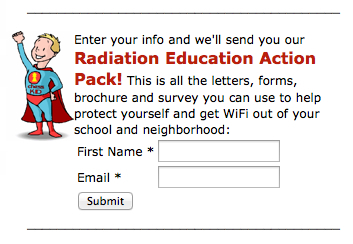
In addition, I taught Oscar and Zara the value of having an opt-in offer to build a list of people’s names and emails. So they came up with an opt-in offer called Radiation Education Action Pack and they now have over 300 names on their list:

That means they have 300 people who are interested in their topic, like what they’re doing and would be open to hearing more from them. So if they upload a new, helpful video, we can email the video link to their list (more relationship building). If they find a fantastic product (for which they would receive a commission on sales) they can shoot a video demo of the product and email it along with a purchase link (and perhaps timed coupon offer, “10% off coupon, valid for 7 days”) to all 300 people.

Since the site launched, the kids have received emails from people in other countries asking to translate their material into different languages. A group in San Francisco used Oscar’s ‘Dear Dad’ letter as part of their package to lobby for a bill on mandatory SARS ratings on cell phones – which they got passed.

Here’s something else noteworthy: Since the kids launched the site (total of 2 weeks work), they have done nothing else with it, yet they earn about $200/month. Their work was all in the set up and they haven’t touched it since. They’ve agreed to receive a percentage of their monthly revenues in cash and the rest goes into their education savings account.

Sure they had me guiding them every step of the way, but they did all the actual work themselves… hmmm… sound familiar? Yes, I’ll be guiding you every step of the way, but you’ll need to do the actual work – from the emotional work, to the physical work, to the organizational work. Of course, you’ll also need to do a bit more work ongoing than my kids, because it’s likely you’ll want to earn more than $200/month!

Your Turn

So now that you’ve learned exactly how three other people turned their top talent, skill, or interest into a business (or two!), it’s your turn to do the same! Let’s go back to the process where I asked you to distill down your answers into a list of your top 3 talents, interests, or skills, or desires….


Your Top 3 Talents or Interests:

1._________________

2._________________

3._________________


NOW…For each of these three options (these are 3 things you are interested in and passionate about – and either have the skills to do something with, or are committed to developing those skills), use the space below to list out your ideas for how you could turn each of these into a new business, or use them in your current business. Don’t worry about how “good” your ideas are, or whether they’re way out there, or impractical. This is a brainstorming session! So just write down whatever comes to mind. Let your thoughts roam, brainstorm with friends, ask for dreams before you go to sleep, do whatever it is that connects you to your soul and/or a higher power. And if you have further thoughts later, maybe you do some brainstorming with a supportive, or wise person in your life, then come back and add more ideas.


How I can turn my Top Talent #1 into a new business, or expand my existing business:

___________________________________________________________
___________________________________________________________
___________________________________________________________

How I can turn my Top Talent #2 into a new business, or expand my existing business:

___________________________________________________________
___________________________________________________________
___________________________________________________________

How I can turn my Top Talent #3 into a new business, or expand my existing business:

___________________________________________________________
___________________________________________________________
___________________________________________________________


At this point, don’t worry too much about how viable your business ideas are, or fret about the details of turning these ideas into a new business, product, or service. Remember that you’re on a journey and these points are all a vital part of the process!

Is there one idea that really makes your heart sing? Or are they all exciting possibilities? Now that you have some ideas, I bet you’re wondering, “but how do I choose my best idea…and build a real business out of it?” …click to find out!


How Do I “Write Off” Business Expenses?

Having a registered company (Proprietorship or Corporation) also enables you to pay for lots of stuff with pre-tax dollars as you can write-off a lot of your activities as ‘business expenses’. Again, exactly what you can claim against your taxes will vary according to your region, so either research this online, or hire a bookkeeper or general accountant for an hour to go through it and get you set up.

Deductible expenses might include the business portion of your real estate taxes, mortgage interest, rent, utility, insurance, equipment depreciation, utilities, painting and repairs, meals out (if you discussed business), trips to attend conferences, items bought for research (books, supplements, machinery – anything directly related to your business) and gas and car expenses.

You can see why you’d want to get your business officially set up as soon as possible! YES you can save a LOT of money by charging all these things as “company expenses”. Which means you get to pay for them with pre-tax dollars and save on your personal income tax bill.

Think of it this way: If you get your company to pay for dinner with your friend – where you brainstorm your latest product or service (so it IS a business dinner), you can pay for that dinner using pre-tax dollars. Then the next time you go out with that friend, they can pick up the tab.

So if your meal is a business expense, then your $50 meal costs you $50. But if you paid for that dinner as a personal expense, and you pay 25% of your income in taxes… that meal just cost you $66.67 – because you had to earn $66.67 to be able to pay your taxes and be left with $50 to pay for your meal.

You can see how this would add up quickly! And why it’s worth it for you to research allowable business expenses (also called tax write-offs) in your country, or pay for 1 hour of an accountant’s time to go through it with you. Click here for a quick run-down of what you can deduct in the USA, or in Canada, or in the UK.

How Do I Tell the Story of My Business?

Once you have an idea for your business nailed down, you’re going to need to dig even deeper and uncover your true feelings about your new business. Your feelings, perceptions and experiences are going to combine to “tell your story” about your business – your products, your service, your solution, your help, your fabulous thing that meets their desire or need.

I’m going to take you through this process because you really need to have your story – stories about your products, your services, your journey – up-front in your mind when you’re designing (or rethinking) the presentation and flow of your site. If you only take one thing from it all, let it be this:

People don’t buy objects, they buy stories.

This means that the benefit your buyer will experience is more important than the ‘thing’ you are selling. It means that the final decision to part with money is an emotional one; yes, you also have to meet all the logical, operational requirements, but the final decision as to whether a site visitor buys your widget, or someone else’s, is an emotional, gut-based decision.

Let me share a few examples (stories!) with you to illustrate exactly what I mean and just how important it is to tell stories about your products and process.

Ebay Experiments

David Ogilvy was one of the first big advertising guys to prove that storytelling (a full page worth of small-font size text) sold extremely well.

When we think of story-based advertising, we may think of those mile-long Internet sales letters, or slick ads in niche-market magazines. But the two examples following show the unmatched power of storytelling even in difficult markets like art and flea market sales.

Chris Tyrell, who teaches artists how to market their work, tells a story about an artist who tested storytelling as a sales technique:

The artist I interviewed conducted an experiment by offering the same artwork (an etching) for sale on two different websites. She provided two dramatically different stories about the piece on each site: one story was extremely poignant while the other was mundane. The piece with the compelling emotional story attached to it sold for almost double the price of the same piece that was described in cool, unemotional and technical terms.”

Chris goes on to provide other examples to prove his point and the one that struck me most was an Ebay experiment; where a group of testers took items purchased at thrift stores and flea markets and then put them up for sale on Ebay… with a good story attached.

They hired professional writers to write a unique, interesting, emotionally-driven story for each piece listed for sale.

What they discovered was that $128 worth of second-hand purchases netted them $3600 on Ebay – simply by attaching an emotionally compelling story to each piece! Following is an example of what they did.

They took this wooden animal figure, purchased for 75 cents at a local thrift store:

They listed it on Ebay, along with an emotionally compelling story about how the seller received this handmade, hand painted carving from her boyfriend after he ran off to Cabo San Lucas with her best friend… and it sold for $108.50!!

They also made sure that the photos of each object were good ones (as shown) – presentation always helps. But the bottom line here is that the customer paid 75 cents for the product and $107.75 for the story!

So how can you work more storytelling into your business, products, or service?

So many people are hesitant to tell their personal stories – either thinking they’re not that interesting, they don’t want to boast, or they simply don’t feel comfortable sharing their private details.

Well, if you can’t tell your own stories, find other ones to tell. Or tell a story about something you read or heard about. As long as it’s interesting, or moving, that’s all you need.

Proving The Point

Justin Gignac is a New York City based artist and entrepreneur. He began selling garbage in 2001 after a co-worker challenged him over the importance of package design. To prove his point, he set out to find something that no one in their right mind would ever buy – and package it (story, branding, positioning and presentation) in a way that would sell.

Looking around the dirty streets of Times Square, garbage was the perfect answer. Who would pay money for garbage?

However, Gignac designed the packaging, positioning and branding for his product – NYC Garbage – in a way that was kitschy, attention-grabbing, told a story, and would automatically prompt people to discuss the story (What is that?? Where did you get that? That’s hilarious! etc.). Here’s what his NYC Garbage cubes look like – and note the price point:

Eleven years later, over 1,300 NYC Garbage cubes have been sold and now reside in 29 countries around the world. Gignac has a retail location in New York, along with his online store: www.nycgarbage.com

I’ll say it again: YES, you must have a quality product or service to offer. You can use an emotionally compelling story to sell a crappy product ONCE, but will that person buy again? And will they refer their friends? And will they go on Facebook, forums, blogs, Twitter and recommend you? Probably not.

Will they go to these same social media platforms and insult you and vent their anger and frustration? They probably will. So dig deep into your own integrity and make sure that whatever you sell is something that you yourself would be happy to have spent your money on. And then go tell stories about it.

In fact, let’s start right now, grab your favourite way of writing or recording and answer these questions – these ones are going to be incredibly useful to you written down, so don’t skip this part!


Read each question one-by-one and immediately write (or voice record) your answer. Or, have a friend ask you the questions and you answer them truthfully and fully:

Your Story

  1. “What made you start this business?”
  2. “How did you come up with the idea for this business?”
  3. “Where did your motivation come from to o er this to people?”
  4. “What’s the story behind your product/service, how did you decide to turn this into a business?”
  5. “Where did you come from, what did you do before this and how did that lead you to here?”

Voila! Guess what? You’ve just written your copy for the ABOUT page on your website – didn’t I tell you this would be useful? But wait, we’re not done…


Your Product Story

If you have a product-based business, or you offer a specific service (like tax returns, or healing sessions, or house appraisals), then also tell stories about each of your products or services. Answer all of these questions for each different product or service you offer – and if you don’t know the answer yet, imagine what it could be and write that. Again, pretend your company is already successful and a reporter has called you and is asking you:

  1. “Why did you choose to do this product, instead of product X (another product you could have done)?”
  2. “There are already lots of X on the market, what made you think there was a place for yours?”
  3. “Why is your product be er than all the others?”
  4. “What do you do differently from other companies?”
  5. “Why has your company succeeded when so many others struggle or have failed?”

The most common place on your site to use these kinds of stories is on your ABOUT page and you will likely use part of it on your Homepage. But you will also use them repeatedly in your marketing materials, teleseminars, interviews, discussions with customers, etc.

It is your own personal stories that engage your site visitor’s emotions. Telling stories about your personal journey, or stories about your product or service lets your site visitor get to know you, and then they feel connected to you; they are emotionally engaged.

If someone feels you’re speaking directly to them, if your story touches their heart, or makes them feel recognition and a resounding “yes!” inside them, then you have them.

So if you haven’t yet, just pretend you’re live on-air and answer the questions above – also give any other details, info, or other stories, examples that pop into your mind. Don’t edit now! Just let everything flow out.

Remember, if you hate to write, then grab your mp3 recording device and record your stories. Then you can have someone else transcribe them into a Word document that you can just copy/paste into your website. Either hire someone from Elance or Fiverr, or get your Mum, daughter, cousin, whoever is willing, to do it for you!

And if you’re struggling to start, or you haven’t written down anything that makes you full-of-beans excited for the next step, why don’t we dive a little deeper into why that might be?

How Do I Choose The Very Best Business Idea?

There’s a common mantra in the advertising world: One ad; one message. This same directive is applied to websites:

One website -> One message

Remember, analyses show you only have 3 – 6 seconds to grab your site visitor’s interest before they click away from your site. For this reason, you need to have a super clear message that instantly conveys what you are about and how your stuff can benefit the visitor – in 6 seconds flat.

Now don’t worry, you’ll definitely get a chance to better determine & express your message, but for now, you just need your three top favourite business ideas… and we’re going to narrow it down to just one.

One Thing At A Time

But how will you pick?? Remember, this is not the be all and end all, this is just the beginning!  You can always expand your website, you can always set up another website, you can always take every business idea you have and put it through the Listen To Your Freedom routine again; for each new passion or interest you have.

But to be successful, especially your first time through building an online business, you need to choose just ONE thing. Pick your top talent, or the thing you are most interested in, or passionate about, and start with that.

All your ideas may be stellar. Perhaps several of them combine into a nice roadmap for growing and expanding your business over the next 5 – 10 years. Great! But for right now, you must pick only one. Choose the best one for your current desires, circumstances, ease-of-implementation, financial situation, and listen to your gut! Your gut (intuition) knows which idea you need to start with.

Be Realistic Yet Visionary

Each of you wants to experience greater abundance and freedom. Yet each of you has your own unique set of circumstances and constraints. So, based on your personal situation, the best overall business idea may not be the best idea for you NOW.

Let me give you an example that explains clearly how to apply these principles and then use the same methods to assess your own personal situation.

Let’s pretend that 3 different people are all skilled jewelry makers, and have the same 3 business ideas to choose from. Each person has to look at their own position and circumstances to make the best decision about which business idea to run with.

So let’s say we need to choose the best business idea from these top 3 talents/ideas:

  1. Start an online retail jewellery store, selling my own pieces and also others, specifically for people who love big, artsy jewellery made from natural materials.
  2. Position myself as a jewellery artist, who creates one-of-a-kind commission pieces in my unique style, blending precious gems with metals, wood, hemp and leather.
  3. Offer online courses and instruction, and also local workshops, in making jewellery, jewellery design, incorporating jeweled elements into art pieces and eventually, how to start and run a jewellery business.

Now here’s the list of our 3 people, each in very different situations, with different constraints and different resources:

Jessica: Is single, she is currently employed full-time and has a good-sized paycheque, she has a few thousand dollars seed capital she can use to get going, and she doesn’t have children.

Karen: Has a partner who brings in good money, but there’s not a lot left after paying bills. She has a baby and toddler at home, her kids are her top priority and her only help is her Mom, a few days per week.

Leon: Is single and is on unemployment/disability payments, because he has a chronic illness that keeps laying him up in bed for a week or two at a time. Or he simply doesn’t have the energy to work more than 4 hours per day. At the moment, he has virtually no start-up capital.

Which Biz Fits Which Person?

So which business idea would you tell each of these people to start with? Look at these factors:

  • How much time do they have per day and per week to spend on their business, right now?
  • In the next year or two, will they have more time available, or the same, or less?
  • How much control do they need to have over their success – i.e. if their business goes crazy and orders pour in, will they be able to cope (grow rapidly and expand), or will they self-destruct?
  • How much money do they have to invest in their business?

Examine the effect these starting parameters will have on how much the person can invest (hiring a professional graphic designer vs. do-it-yourself, for example) and also how much time they’ll be able to spend on developing and promoting their business vs. the likely demands of each business idea.

In my opinion, Jessica should go with Idea #1 (the online store) because a retail store requires a lot of inventory, which means money up-front. If she starts by selling other people jewellery lines, she can easily get this going during her time after work and on weekends.

Most of her work will be in the set-up and she can easily power through the intense workload because she is in good health and does not have any kids. Then, as her time allows, she can add her own pieces to her line-up.

Once her business is making good money, she can switch to part-time or flex-time with her job, or quit altogether. If her business explodes and she starts selling to retailers and high-end customers worldwide, she will have the cash (and ability to raise cash) to finance the additional capital required to stock larger inventory and hire support staff. She can also implement Ideas #2 and #3 when and if she wishes.

Karen should go with both Ideas #2 and #3 (commissioned work and instruction). Due to her time constraints, she will only be able to do a few commissioned pieces here and there – but they will also invigorate and re-energize her to the point where they may even make up for missing sleep to work on them!

She will be able to offer one-day local workshops while her Mom takes the kids and if her Mom is really capable and her husband willing to help, she may even be able to do 2-day workshops.

These two features are synergistic because they support and enhance each other. A customer will have a higher perceived value for the jewellery piece if she sees that the artist is also an instructor and mentor for other jewellery artists. And the workshop attendee will be drawn by the idea that the teacher is a professional artist who also makes money selling her jewellery as commissioned pieces, rather than just as a hobby.

This business further works for Karen because she can control and limit her customers and workshops as desired, because her children are her priority.

As her children grow up and once they are in school all day, she could then add Idea #1 to her business.

Leon should go with Idea #2 (commission pieces) and the online course aspect of Idea #3. Because he is severely restricted in both time and money, he needs to go with a business that requires minimal investment and where he can totally control the workload.
If he charges a 50% deposit to begin work on a piece, this will cover all his material costs, so he will not have to fund anything himself. He can also focus on visually-based promotion methods like Pinterest, which require only minutes to implement.

At his own time and pace, he can slowly put together an online instruction course on jewellery making using videos and eBook instruction manuals. He will then have a revenue source that is not tied to his time or presence.

As he has time to blog, he can also add Amazon affiliate links to his blog posts for his jewellery tools, supplies, products, etc. which also take only minutes to implement, but can generate ongoing automated revenue.

If and when his health improves, he can add the other component of Idea #3 (live workshops) to his business and eventually, if he wishes, Idea #1 (the online store selling other jewellery lines).

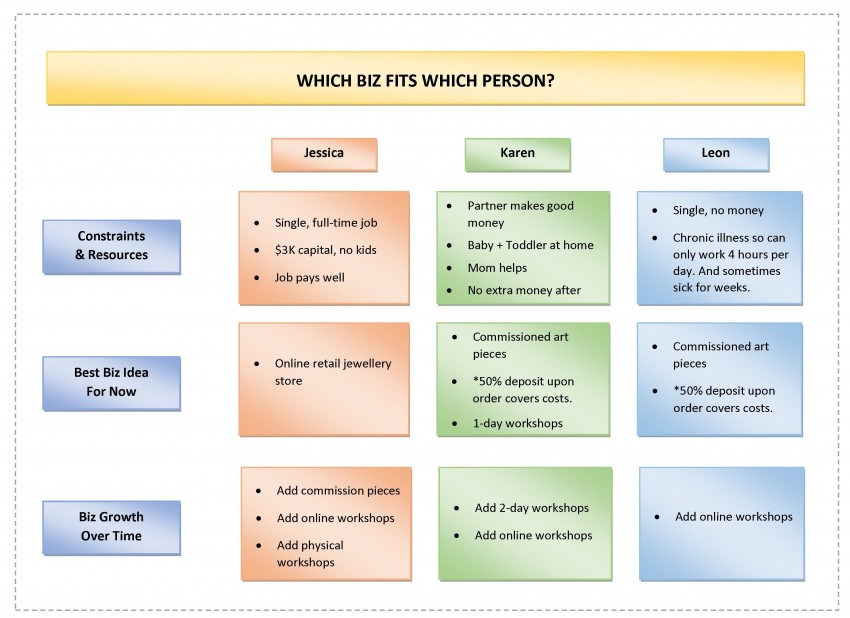
So here’s a quick look at which business idea best suits each person’s unique circumstances for right now, and how they can grow their business over time:

Here’s another round of the same thing, but this time all three people are already running their own blogs or businesses based around a shared love of outdoor, wilderness and back country exploration. This will give you an idea of how to expand or change your business and/or website after it’s established, in order to suit your new needs or dreams.


So. Each of our 3 business owners need to choose the best business idea from these top 3 talents/ideas:

  1. Start an online retail outdoor gear store, selling my company’s products and also some other select brands, for people who enjoy multi-day backpacking treks and back-country solo sports.
  1. Write a memoir about my backpacking adventures, and sell it online.
  1. Offer online courses and instruction in wilderness survival and back-country preparedness, as well as offering local workshops for beginners to learn about exploring the back-country safely.

Now here’s the list of our 3 hypothetical people, each in very different situations, with different constraints and different resources:

James: Already owns and operates a small local retail business that manufactures his innovative tent design and also sells top-quality outdoor gear. He loves what he does but is getting tired and wants to increase his revenues so he can afford to spend more time with his kids. He’d also like to use that breathing room to set up some automated income related to his business and passion.

Celine: Works part-time to allow for hiking and camping trips, and maintains a blog about her adventures. She’s a mom of two, has a partner making a good salary, and she has a little spare time and some seed money saved away that she’s willing to invest in her own business.

Paula: Has a basic website featuring herself as a back-country guide or consultant for hire. She currently has a regular client who contracts her to be the back-country guide at a wilderness lodge for half the year. She runs her business so that she makes enough to get through the other six months, but has no capital left over. She has no kids or partner and lots of spare time, but after a few injuries she’s realizing she won’t be able to run her guiding business forever. She’s a fantastic photographer, and has a huge collection of original shots from years spent in the bush, just sitting around on flash drives.

Which Biz Idea Fits Which Person?

Remember the factors we need to look at:

  • How much time do they have per day and per week to spend on their business, right now?
  • In the next year or two, will they have more time available, or the same, or less?
  • How much control do they need to have over their success – i.e. if their business goes crazy and orders pour in, will they be able to cope (grow rapidly and expand), or will they self-destruct?
  • How much money do they have to invest in their business?

In my opinion, James should go with Idea #1 (creating an online component to his retail store), because he has the capital and the inventory, as well as the supplier contacts and business know-how, to run an online store.

Most of his work will be in the set up, which he can either do during slow times at the shop, or, outsource the website design and programming, and use his time to delegate and oversee the building of his website.

Once the online store is making good money, he can hire employees at his storefront and switch to a part-time management role, while he keeps an eye on the site from home. If his business takes off and he starts selling to retailers and customers worldwide, he’ll have the cash (and earning ability) to finance a larger inventory and hire more support staff.

People with existing retail businesses may underestimate the sales growth that can come from simply launching an online version of their existing store. But if you already have a physical, retail business, you are primely positioned to add an online store with very little extra hassle. Think about it: You already know what sells, you have relationships and payment terms with manufacturers and distributors already set up, you already have warehouse or storage space for products and you likely already have a relationship with your bank for a loan or line of credit.

The original Garden Pharmacy


Let me give you an example: My cousin and his biz partner own a physical retail pharmacy in Covent Garden in London – a prime retail location – and they were already generating over $2 million/year in revenue from the physical store; which also has a spa (nails, facials, waxing, etc.) and a special section for high end cosmetics and perfumes.

When they launched the online version of The Garden Pharmacy, their sales doubled within a year. But the really amazing thing they discovered is that many of their local customers – who literally lived with 5 minutes walk of the pharmacy – preferred to order online because it was easier! And you know what happens when you make things easier for people… they buy more frequently.

Re-brand of retail pharmacy to match online store

Of course, with such a rapid increase in sales, my cousin had to find additional warehouse space and also hire more staff to fulfil orders – but again, not a big deal when you have cash flow pouring in! But if you don’t have that kind of cash available, outsourcing warehousing and order fulfilment is a great way to set yourself up so that you can grow as big and as fast as the market allows, with no extra work or hassle for you!

So getting back to James and his outdoor gear store: After he’s launched the online version of his existing retail store, when he feels he’s ready, he can step aside even more and create more time and space to implement ideas #2 (writing a book) and #3 (creating and teaching courses and workshops) if he likes. Since his outdoor gear store is well-known at this point, he will have a large email list of opt-ins and customers, who already appreciate his dedication and expertise, and who will be interested in his books and courses.

At this point, he could easily step back from the front lines and manage his automated income from book sales, online programs, and his online store (or any combination of the above) with a minimal amount of work hours from the convenience of his laptop.

Of course, if his online store does really well, and he wants to reduce his work load and hassle factor even more, then he could close down his physical retail store (removes the overhead of rent and the hassle of staff), use a contract manufacturer to produce his tent, outsource all his product warehousing and fulfillment, outsource his online ordering and customer service and then just handle the money and oversee things from his computer. Once everything is set up and running smoothly, he shouldn’t need to spend more than 5 – 10 hours a week just to keep things rolling.

This is the business model we use for our online health store. We sell over 350 products on our website and we have outsourced every component, so that we can go to Hawaii for a month or two with no disruption whatsoever to our business or revenue.

Now let’s take a look at Celine; who works part-time to allow for hiking and camping trips, and maintains a blog about her adventures. She’s a mom of two, has a partner making a good salary, she has a little spare time and some seed money saved away that she’s willing to invest in her own business.

Celine could start with Idea #2, writing a book. Since she’s been blogging all this time, she already has most of the material needed for a book! She can use her free time to compile her posts, add to them wherever needed, and format her book into a self-published eBook and/or physical book, which she can then sell on her existing site, using LTYF tools to increase traffic to her blog.

Idea #3 (online and local courses and workshops) would also be easy to implement on her existing blog site, especially as her book starts to take off and people who want to get into back-country exploration start asking her for advice. She can shift the focus of her hiking and offer some of that time to small local groups who want to learn about wilderness survival, gear preparation, or who just want a mentor until they feel confident to hike by themselves.

She could even add Idea #1 (online retail store), but instead of going to the trouble of manufacturing, warehousing and shipping products, she could create an online affiliate store, where she collects affiliate cash from sales made through her website.  She can use her blog to review and recommend products from her own personal experience, and receive 40 – 60 percent commission on any sale made through her website.

This way, she can even score some great equipment from companies who’d like her to review their products – once she’s gathered a large enough email list and positioned herself as a trusted expert in the field. That way she’ll never need to put down capital on her store – unless, once she’s established, she wants to go ahead and start manufacturing her own brand, or retailing other brands!

These features are synergistic because they support and enhance each other. A customer will be more likely to trust her judgment and recommendations of products if he sees that Celine is not only a down-to-earth, nature-loving backpacker like him, but also also an instructor and mentor who uses the same gear in the back-country that she’s selling on her site.

Being a published author greatly increases her credibility, and her workshop participants will certainly be interested in reading her book. They will also be drawn in by the fact that she is a notable outdoor gear expert with years of in-the-field experience, as seen on her blog.

This business further works for Celine because she can control and limit her in-person workshops as desired, and be virtually hands-off on her affiliate store, because her children are her priority.

But remember, the LTYF directive is to start with just one thing. So in Celine’s case, she would start with the book or eBook. And her site would focus on that – she would base this first pass through LTYF on that ONE business idea and get it up and running. As she becomes fluent with the LTYF tools and process, she can add in the other parts of her overall plan.

Now let’s check in with Paula. Remember, Paula contracts her services (featured on her basic website) as a back-country guide at a wilderness lodge for half the year. She runs her business so that she makes enough to get through the other six months, but has no capital left over. She has no kids or partner and lots of spare time, but after a few injuries she’s realizing she won’t be able to run her guiding business forever. She’s a fantastic photographer, and has a huge collection of original shots from years spent in the bush, just sitting around on flash drives.

Paula should go with Idea #3 (online courses and in-person workshops) first. Because she has six months off every year, she has plenty of time to create content to offer online, teach classes or workshops in person, and take beginner groups out for short hikes to learn the ropes of back-country exploration. If she wants to limit all heavy physical activity to give her injuries time to heal, she can focus on the online aspect, as well as more technical or theory-based workshops.

This is the best idea for her because it’s a natural extension of what she’s already so good at, and loves doing, but is less pressure on her body and has more potential to generate income. She also already has all the photos she’ll need to illustrate her courses and what she’s teaching! And if she needs live, action video for her courses, then she can shoot it during her guide trips, or during her 6 months off.

Here’s something else to keep in mind: Paula’s online course could also appeal to the back-country version of the “armchair traveler”. Many people purchase travel books, guides and videos with no intention of ever leaving home! Think of National Geographic magazine; the opportunity to live vicariously through the guide or adventurer is enough.

Maybe Paula will discover a huge market for her courses in Germany – of people who dream of someday visiting the wilderness of North America, but for now, this is the closest they can get to actually experiencing it. Or maybe she will also produce a course on wilderness survival and appeal to off-the-grid groups and survivalists. NOTE: She would want to do some keyword research to make sure these groups can find her site.

And if Paula chooses to do another season or two of guiding, the online courses can still generate extra automated income while she’s away.

Paula also has time to blog – and she has a ton of great stories and photos from her guiding business.  She can add Amazon affiliate links to her posts for all her favourite gear and tools, and/or set up an affiliate shop like Celine, all of which generate ongoing automated revenue.

In her own time, she can collect her stories and pictures together into a beautiful coffee-table book and sell that on her site as well (Idea #2). And if it comes time to quit guiding all together, with the capital she’s generated over time with these different ventures, maybe she wants to implement Idea #1, and start building her own brand of gear to retail online.

But again, you see how Paula needs to choose just ONE of the ideas based on her top talent, and start just with that one thing first? So she would use the rest of the LTYF program to get her first online course produced and available for sale on her website – while building an email list of people interested in back-country exploring.

Okay, that’s a lot of information! So let’s pull it all together into an easy chart. Here’s a quick look at which business idea best suits each person’s unique circumstances for right now, and how they can grow their business over time:

Ready to figure out what your final idea (for this moment in time) is going to be?


Write down your top 3 business ideas (if you don’t have any yet, go generate some!):

1.____________________

2.____________________

3.____________________

Now based on the detailed examples above and the parameters we ran the ideas through, which of your business ideas do you feel would be the best one for you to start with? Ask yourself these questions (and write down your answers!):

How much time do you have per day and per week to spend on your business, right now?

In the next year or two, will you have more time available, or the same, or less?

How much control do you need to have over your success – i.e. if your business goes crazy and orders pour in, will you be able to cope (grow rapidly and expand), or will you self-destruct due to family demands or illness? Plan accordingly:

How much money do you have to invest in your business?


Consult Your Critics and Encouragers

If you’re still not sure what you should do, go back to the wise people in your life. Choose a mix of people who are supportive and people who are more critically-minded, as they will help find the holes in your ideas.

Present all three ideas to each of these people and ask them which one they think is the best of the lot? Which one do they think ‘fits’ you the best? And which one do they think is the best business venture for you at this time?

After you’ve brainstormed all three ideas further with these helpful people, you’ll likely have a better idea of which one you want to implement; or implement first.

So do that now: go back to your list of your top three business ideas and pick one of them. Pick the one where you feel a “click” in your gut when you ponder it.

Pick the one that realistically is most likely to meet your current needs and provide a launch pad for you.

Pick the one that is easiest to launch and just get started.

Pick the one that motivates you the most.
 Pick the one you love the most.
Pick the one that makes your heart sing the loudest.

And write it down. Don’t worry, you can come back and improve on this idea if you get more inspiration after listening to the Audio and watching the videos in the next few units.


My Best Business Idea For Right Now:

________________________________

WHY:

________________________________

________________________________

________________________________

________________________________


Need a little more to go on? Here’s a good overview of common questions and dilemmas faced by people trying to choose which business idea to go with.

In the audio for this module, I dispel common business myths and share some of the most effective tips and strategies I’ve found that work really well in choosing the best idea to launch by listening to your freedom, instead of your fear.

  • Learn why going by the books and adhering to age-old business wisdom isn’t always the best way to go.
  • Explore creative ideas to generate funding or investment for projects you don’t actually have the capital for
  • Get inspired by real-life stories of unconventional (and successful!) approaches to business

And much more!

Click here to download the audio (right-click and Save As): Choosing Your Best Idea

Or click PLAY to listen:

Audio Follow-Up

At around 6:40, I reference defining who your ideal customer is – you can learn more about the basics of this process, or you can jump to an energetic way to connect with potential customers.

At 8:30 we talk about ideas for financing – we’ve got lots more about creative, out-of-the-box ways to use your credit cards to finance your business, secure loans from family or friends, get a bank or investor to back your idea, or even crowdfunding for your new business or product.

17:00 – LTYF forum – edit out

And if you still need more for your brain to chew on, why don’t you spend some time checking out your “competition” and defining your own special niche?


How Do I Set Myself Apart From My Competition?

When you have a niche, or business idea that you are excited about and want to pursue, or when you’ve got something up and running but business is slow, pull back for a short time and do a quick scan of your competitors in that niche.

This will give you a good look at whether your idea is specialized enough to stand out, or not. If you find that it isn’t, it doesn’t necessarily mean that you have chosen a bad idea, or that the market is already flooded with people doing what you want to do, so you better find a new idea. Not at all. Remember all you have learned about your special uniqueness!

What this will help you to do is realize where you need to emphasize, develop, or dig deeper to REALLY set yourself apart from others, or where you need to speak more authentically to your ideal customer.

Kitchen Wisdom

Let’s take the Recipe Blog niche as an example. Been online lately? You’ll notice that the Internet is completely flooded with really great baking and cooking blogs. This niche is super-developed, with gorgeous photos, original artwork, cohesive branding, cookbooks for sale, you name it. Sounds like a bad niche to pick doesn’t it? Even if you love cooking more than anything.

But wait! Look for the opportunities, look for the holes in marketplace…

Let’s say you specialize in gluten-free baking – that’s a niche specialization isn’t it? Go search for gluten-free baking sites, research your competition, and you will find the same thing: Thousands of them. So dig further…

What about gluten-free and sugar-free? Ah now we’re talking! Sugar is used in abundance to make up for the browning and mouthfeel missing from gluten-free (GF) baking. Go ahead, try and find sites with great recipes for GF, sugar-free baking. Good luck. Because there are very few – and none that I’ve found with good recipes – good enough that my kids will eat them.

So now we have niched down within your field of interest to a sub-sub-category that is wide open and begging for inspiration and leadership! What if you became the expert on healthy, natural sugar substitutes like stevia, xylitol (from hardwood trees, not GMO corn), lo han guo (Chinese fruit extract) and Thaumatin (extracted from African Ketemfe berries). AND you become one of the few places where customers can purchase these sweeteners?

Or, what if you realize that everyone features printed recipes and photos. So you decide to stand out by shooting a video for every recipe. Maybe you wear kooky outfits, or maybe you love haute couture, so you dress to the nines – you choose a visual persona that encapsulates YOU. And that becomes yet another way to stand out.

Glam Girl Rachel Khoo in her Tiny Paris Kitchen

Maybe you’re a guy and you talk about photography while you’re cooking. Maybe you tell jokes, or goof around, or swear a lot. There are hundreds of ways to differentiate yourself! Just make sure you are pulling out or emphasizing an authentic part of you, not acting.

Maybe you take it one step further and you go gluten-free, sugar-free and grain-free… Now you are hitting the paleo diet market, the digestive disease market and the weight loss market. Maybe you become the place to go for supplies and you come up with a killer grain-free flour blend of potato flour, coconut flour, almond flour and cassava flour. Nobody else is selling this blend and as your recipes become popular, and word of your culinary prowess spreads, you decide to package up your blend and sell it on your website, and then on Amazon. And then into Whole Foods.

Okay, I’ll stop there! But you get my point: Finding out you have rigorous competition, or that your market is already flooded, doesn’t necessarily mean you have to find a new idea, or different niche to play in. It may just mean you have to dig deeper, specialize further, and become even more unique or different.

But you DO have to take a look at what’s happening in your chosen field. See what people are already doing, so you can figure out how to make yourself stand out.

Don’t put your head in the sand and invest hundreds of hours of work and wads of cash in a doomed enterprise, just because you are afraid to take an honest look around you. Knowledge is power and lemons can always be made into sugar-free lemonade!